
Defender vs. CrowdStrike: A Real‑World Test Inside a Major Bank
We recently completed a Microsoft Defender for Endpoint (MDE) Implementation and Security Validation engagement for one of the largest regional banks in the Northeastern…
DefenseLine AI watches your cloud, identity, DevOps and endpoints, investigates every alert like an analyst would, closes the noise with its reasoning on record and calls a named Digital Edge engineer when it matters. Every alert also becomes compliance evidence, so audits stop being a project.
36,098 alerts in 24 hours · 4 needed a human
DefenseLine AI is Digital Edge’s AI-native MDR (managed detection and response) platform with compliance automation built in. It collects telemetry from cloud accounts (AWS, Azure, GCP), identity and productivity (Microsoft 365, Entra ID, Google Workspace), DevOps (GitHub, GitLab, CI/CD) and endpoints (SentinelOne, CrowdStrike). Rules in the SIEM raise alerts; an AI orchestrator that knows your environment investigates each one in several rounds, then either closes it with fully logged reasoning or escalates it to an in-house Digital Edge analyst. Every alert, closed or escalated, produces a compliance artifact mapped to HIPAA, PCI DSS, GLBA, HITRUST, ISO 27001 and SOC 2.
It covers three jobs in one operation: managed detection and response, vulnerability identification and management, and compliance evidence with automated audit preparation. You may also see it written as Defense Line AI or Digital Edge Agentic AI SecOps.
A recent 24-hour window from the live DefenseLine platform. Not a demo environment.
Most MDR services were built when the endpoint was the perimeter. Today attackers walk in through a stolen credential, a misconfigured cloud role or a trusted SaaS integration, and none of that runs on a laptop. Endpoints cover roughly 30% of the real attack surface; your AWS accounts, Microsoft 365 tenant, GitHub repositories and identity provider generate the signals most MDR tools never see.
Signal categories watched. DefenseLine AI covers all five.
Illustration based on the five telemetry categories DefenseLine monitors
Follow a real-world alert through the platform, check which of your systems it would watch, and compare the cost with the usual way of buying security.
SIEM rule: the same finance manager signed in to Microsoft 365 from New York and from Frankfurt 40 minutes apart. Severity: high.
The AI gets the client profile first: single sign-on through Entra ID, staff VPN with egress points in New York and Frankfurt, conditional access requires a managed device, the finance team travels.
It asks for 24 hours of sign-in logs for this user, the device compliance state, the MFA method used and the list of VPN egress IP addresses.
The Frankfurt sign-in came from the company VPN egress listed in the profile, on a compliant managed laptop, with number-matching MFA. It asks one more question: any new mailbox rules or app consents in the last 24 hours?
No mailbox forwarding rules, no new OAuth app consents, no unusual downloads.
The location change is explained by the company VPN. The full reasoning and every query are logged with the alert. Time: about two minutes, no analyst needed.
Evidence of monitoring and review mapped to SOC 2 CC7.2, ISO 27001 A.8.16, HIPAA §164.312(b) and PCI DSS 10.4.1.
CloudTrail: an access key was created for the IAM user “ci-deployer” from an IP address never seen before, followed by a list of all S3 buckets.
Deployments run in GitHub Actions; “ci-deployer” should only be used from GitHub runners; no person uses it. Two production buckets hold patient data (PHI).
It asks for seven days of CloudTrail for this user, the GitHub audit log for workflow runs at that time, and reputation data for the source IP.
The IP belongs to a residential internet provider, not GitHub. No workflow ran at that time. Downloads (GetObject) from a PHI bucket started three minutes ago. It asks for GuardDuty findings and any other new keys.
One more key was created for the same user; GuardDuty flags unusual API activity. This is a stolen CI credential in use.
A named Digital Edge cloud analyst is paged with the timeline and evidence, plus the recommended containment: deactivate both keys, rotate the GitHub secrets, block the IP, review S3 access logs for data taken.
Incident record mapped to HIPAA §164.308(a)(6), SOC 2 CC7.3 and CC7.4, ISO 27001 A.5.25 and A.5.26, and PCI DSS 12.10.
EDR: Excel started PowerShell with an encoded command on a finance laptop.
Macros are blocked by policy except one signed finance add-in; IT runs signed maintenance scripts nightly; the add-in vendor’s update domain is on the approved list.
It asks for the full process tree, the decoded script, the code signer and the network connections that followed.
The parent is the approved, signed add-in updater. The decoded script checks the add-in version and downloads from the approved vendor domain. The file hash is known; no other connections.
Legitimate update activity. The reasoning is logged, and a narrowly scoped rule change (this signer and path only) is suggested to cut the noise.
Malware-protection evidence mapped to SOC 2 CC7.2, ISO 27001 A.8.7 and HIPAA §164.308(a)(5)(ii)(B). The monthly self-audit reviews the suggested tuning.
Tick what your company uses. See what DefenseLine would watch, and what an endpoint-only MDR would miss.
Select your systems to see the gap.
Get a coverage reviewChange the numbers to match your situation. Defaults are typical figures from public price guides; your own quotes may differ.
Per month: $0
Per month: $0
From $1,500 per month
Your DefenseLine quote depends on log sources, volume and frameworks. An internal security team typically costs $20,000–$50,000 per month.
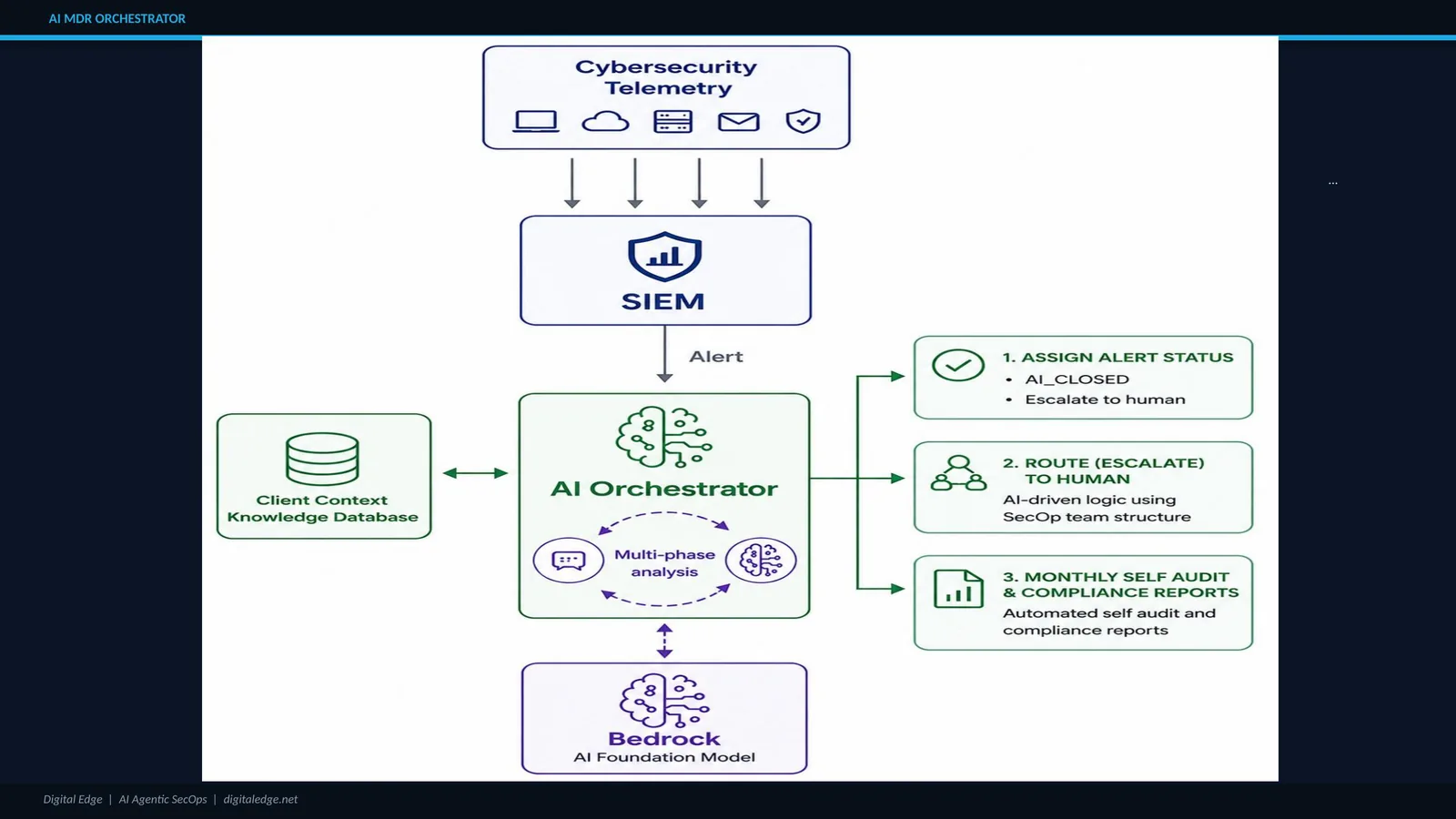
DefenseLine chains AI after standard rule-based detection: the speed and explainability of a SIEM, with the depth and context of an analyst. Every decision is traceable, and every decision produces evidence.
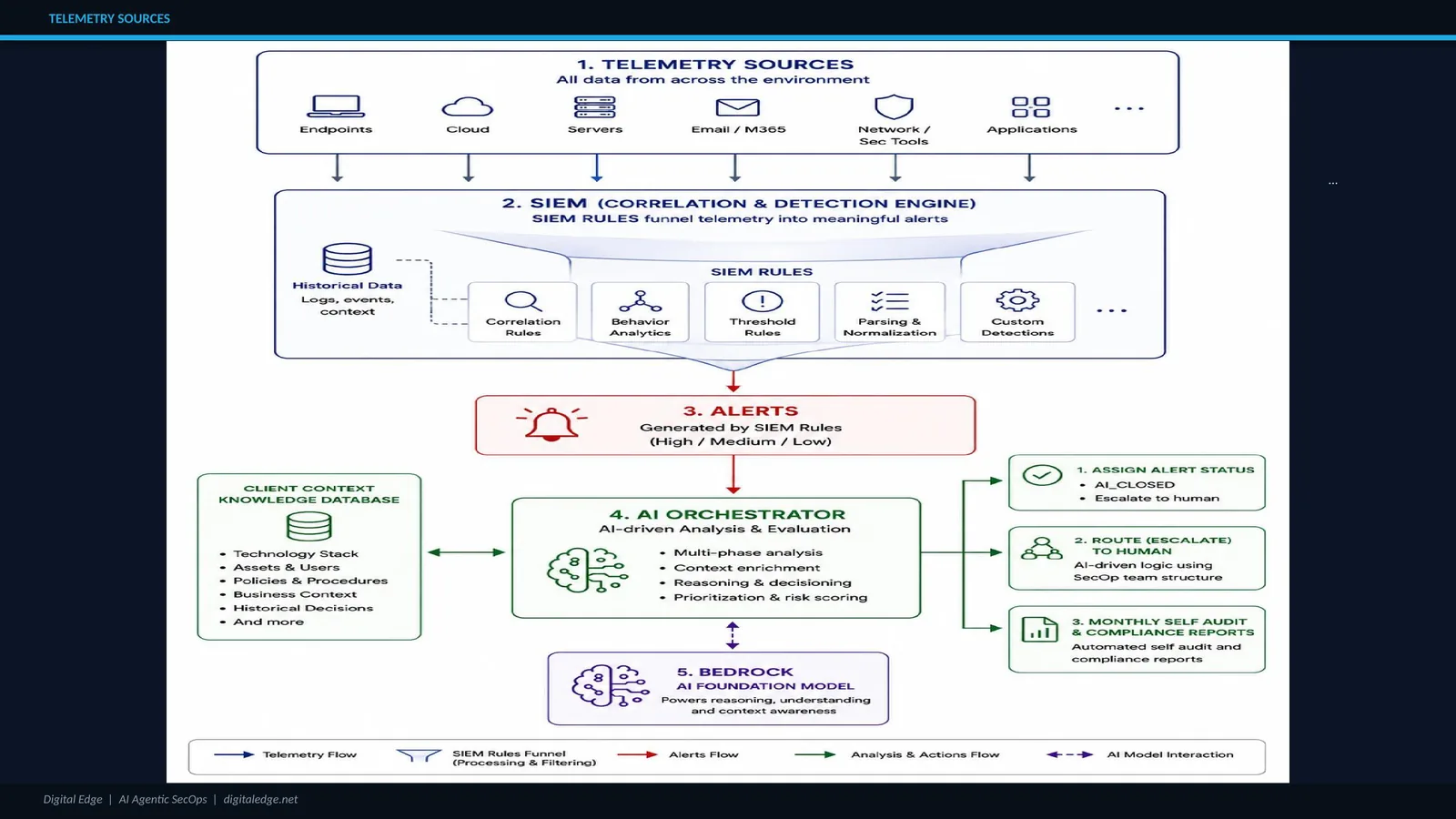
Cloud, identity, DevOps, endpoints and network logs flow into the SIEM, where rules raise alerts.
The AI receives a profile of your topology, log sources, identity model and known baselines before it reads the alert.
The AI asks for the logs it needs, reads them, and asks again until it can make a defensible decision.
No “medium priority” scores: closed with logged reasoning, or routed to the right in-house analyst with the evidence.
Each alert becomes a compliance artifact mapped to your frameworks. Monthly, AI reviews everything for blind spots.

AWS, Azure and GCP; Microsoft 365, Entra ID and Google Workspace; GitHub, GitLab and CI/CD; SentinelOne and CrowdStrike. Attackers live where traditional MDR does not look.
Every alert starts an iterative investigation. The result is a clear decision with auditable reasoning, not another “medium” alert for your team to triage.
Closed or escalated, every alert creates an artifact for HIPAA, PCI DSS, GLBA, HITRUST, ISO 27001 and SOC 2. When a framework changes, AI re-reads existing evidence through the new lens.
A per-client Environment Profile (topology, log source IDs, identity model, baselines) goes with every AI request. The system gets smarter every month.
Continuous reconnaissance of your public footprint: DNS, cloud (AWS, Azure, M365) discovery and exposed services, with findings tracked to closure.
A cybersecurity attorney on staff and reporting built on the CIS RAM risk method, co-authored by Digital Edge’s Michael Petrov. Evidence that stands up to OCR, PCI assessors or a plaintiff’s attorney.
SIEM, SOAR, MDR, GRC and compliance reporting in one operation, from $1,500 per month instead of $20K–$50K a month for an internal security team.
Escalations go to Digital Edge engineers in New York, by specialty and schedule. No outsourcing, no reseller chain, one team from first call to 3 a.m.
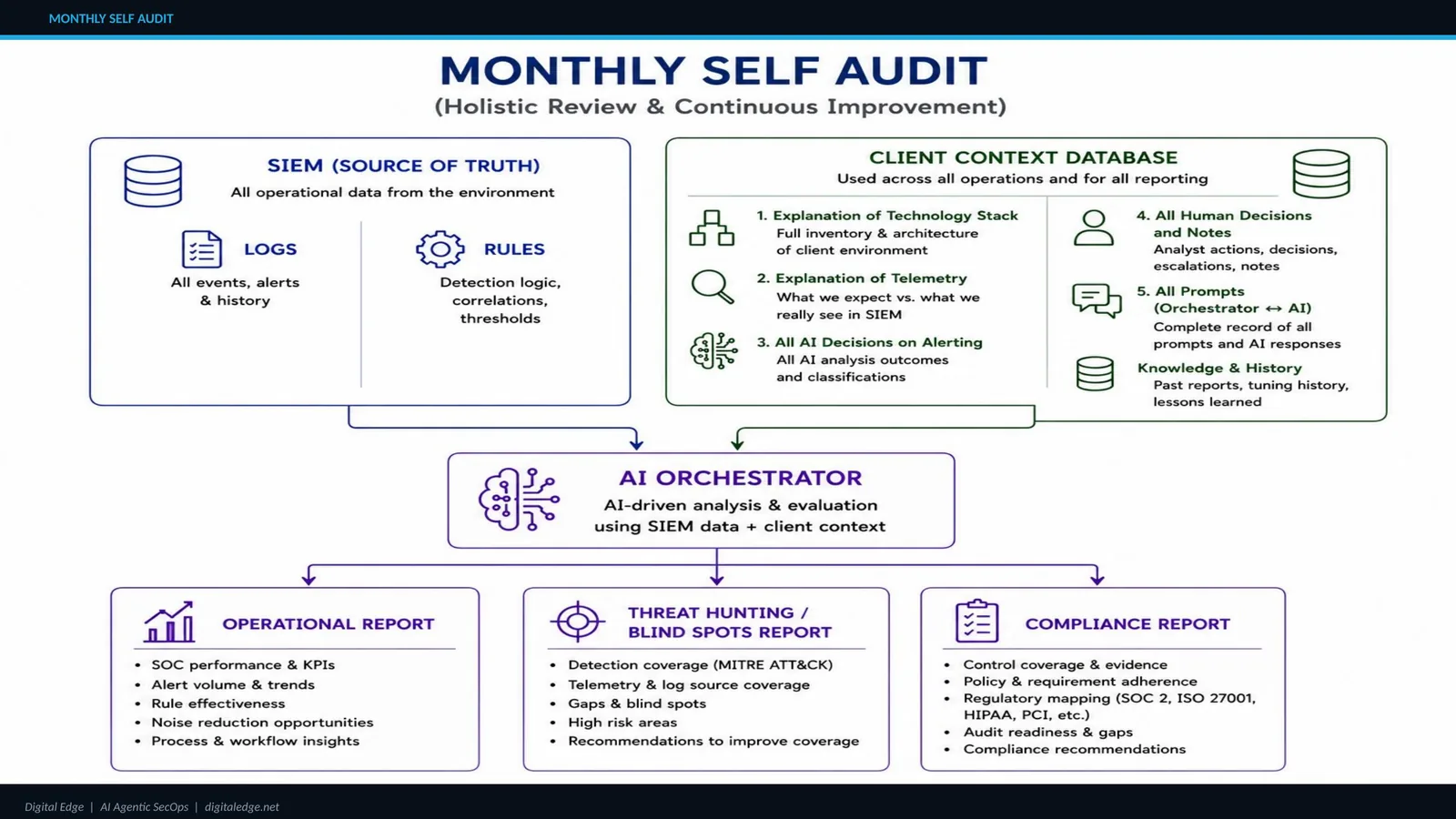
Every month AI reviews all alerts, decisions and analyst notes and delivers three reports: operations, threat hunting and blind spots, and compliance.
Excellent products exist in every category below. The difference is the business model: most of them need more people, more vendors or more of your time before they protect anything.
| What matters | DefenseLine AI | Traditional MDR | Compliance automation software | Enterprise security platform | Building an in-house SOC |
|---|---|---|---|---|---|
| What you buy | An accountable operation run for you | A monitoring service | Software | Platform licenses | Hiring, tools and training |
| Who runs it day to day | Digital Edge in-house engineers | The provider, endpoints only | You or a consultant | You or a reseller | Your own team |
| Cloud, identity and DevOps coverage | Native, all layers | Rarely; endpoint first | Configuration checks only | With extra modules | Whatever you build |
| A decision on every alert | Yes, 99%+ closed by AI with reasoning | Some; high ticket volume | No | With SOAR playbooks you maintain | Depends on headcount |
| Compliance evidence from operations | Every alert, automatically | No | Collected, not produced | No | Manual |
| Extra resources you still need | None: one team, one bill | A GRC tool and audit prep | MDR, staff and an auditor | SOC staff, SOAR engineering | 5+ analysts for 24×7 |
| Legal defensibility | Attorney on staff | No | No | No | Outside counsel |
| Entry cost signal | From $1,500/month | Per endpoint, plus tools | $7.5K–$60K/year, plus auditor and staff | Per endpoint/year; SOAR can reach ~$250K/year | $20K–$50K+/month |
Categories, not vendors. Costs from public price guides (2026); every quote varies with scope.
| Signal source | Examples | Covered |
|---|---|---|
| Cloud infrastructure | AWS (CloudTrail, Security Hub, EKS, DynamoDB), Azure (Entra, Intune, Defender), GCP | Yes |
| Productivity & identity | Microsoft 365, Entra ID, Google Workspace, JumpCloud, Kandji MDM | Yes |
| DevOps & code | GitHub, GitLab, Atlassian (Jira, Confluence), CI/CD pipelines | Yes |
| Endpoints & EDR | SentinelOne, CrowdStrike Falcon, custom endpoint agents | Yes |
| Anything else | Syslog sources, custom APIs, existing SIEMs (Splunk, Microsoft Sentinel) | Yes |
DefenseLine reads the tools you already own. Keep your EDR, your cloud accounts and your identity provider; we connect them, write the Environment Profile with your team and start investigating.
How alerts move from your systems to a decision and a report.
Pure AI reads everything from the month: all alerts and decisions, every AI prompt and response, analyst notes and your client context. It produces:

A mid-sized digital marketing agency handling consumer PII for national brands held ISO/IEC 27001:2022 certification and faced its surveillance audit. With an ISO 27001 Lead Auditor, it ran a pre-audit that mirrored the real one. The review found 13 improvement opportunities and no nonconformities; the agency fixed them and passed the surveillance audit with zero nonconformities.
It still had to schedule a readiness window and build the evidence package by hand. DefenseLine removes that step: every threat detected, triaged and resolved also produces the documentation an auditor expects. Clients do not prepare for audits; they open a folder that has been building itself since day one.
Talk to us about your next auditDefenseLine AI is an AI-native managed detection and response (MDR) platform, operated by Digital Edge, that combines 24×7 threat detection, vulnerability management and compliance evidence in one service. It monitors cloud, identity, DevOps and endpoint sources, investigates every alert with AI and produces audit evidence automatically.
Traditional MDR mostly watches endpoints, applies the same playbook to every client and produces tickets for people to triage. DefenseLine covers cloud, identity and DevOps as well, gives the AI a profile of your specific environment, closes more than 90% of alerts with logged reasoning, and turns every alert into compliance evidence.
For routine alerts, yes: it closes them only after an investigation of usually 4–5 rounds and records its full reasoning, which you can audit. Anything it cannot clear with confidence is escalated to a named Digital Edge analyst with the evidence attached. In a recent 24-hour window, 4 of 36,098 alerts needed a human.
HIPAA, PCI DSS, GLBA, HITRUST, ISO 27001 and SOC 2 are proven in production. Evidence is framework-agnostic, so it can also be mapped to NIST CSF, NYDFS Part 500 and others; when a framework changes, AI re-analyzes existing evidence through the new requirements.
No. DefenseLine connects to what you already run, such as SentinelOne or CrowdStrike, AWS, Azure, GCP, Microsoft 365, Google Workspace, GitHub and GitLab, and can work alongside an existing SIEM such as Splunk or Microsoft Sentinel.
Plans start at $1,500 per month. The price depends on your log sources, volume and the frameworks you need evidence for. For comparison, an internal security team typically costs $20,000–$50,000 per month.
Every report and artifact is built for legal defensibility: Digital Edge has a cybersecurity attorney on staff, and its risk method follows CIS RAM, co-authored by Michael Petrov. The evidence is designed to hold up in front of OCR, PCI assessors, ISO certification bodies and opposing counsel.
Book a 30-minute call. We look at your environment and frameworks, show the platform on live data, and agree which sources to connect first. Your engineers can do the changes themselves if your policy does not allow vendor access.

We recently completed a Microsoft Defender for Endpoint (MDE) Implementation and Security Validation engagement for one of the largest regional banks in the Northeastern…

ABOUT: XYZ is a non-profit organization dedicated to enhancing maternal and infant health. As a 501(c)(3) charity, XYZ relies on donations to fund its mission. To proces…

This year, Digital Edge served as a contributor for Verizon’s Security Breach report by providing details and our analysis of our client’s breach reports (Note: None of…
Book a live demo: we walk through a real alert, the AI investigation, the compliance artifact it creates and what your first month would look like.