NGINX2Root (CVE-2026-123007): How DefenseLine AI Found It on a Client Server in 48 Hours
A critical nginx flaw went public on Wednesday. By Friday, DefenseLine AI had found it on a live client server.
When NGINX2Root was disclosed, no hand-written rule existed for it. DefenseLine AI tested the client's environment, found a vulnerable nginx server and delivered the evidence and the fix. This is the sequence, and the checklist for anyone running nginx.
DefenseLine AI is Digital Edge's agentic security operations platform, designed, built and run by our own engineers. It brings cloud, identity, DevOps and endpoint telemetry into one place, investigates every alert with AI that knows each client's environment, and turns every decision into compliance evidence. It also tests client environments for newly published vulnerabilities. This is the story of how it caught NGINX2Root, a critical nginx flaw, 48 hours after disclosure.
A critical flaw went public on Wednesday
On November 18, 2026, five memory-safety flaws in nginx were disclosed together under the name NGINX2Root. nginx is one of the most widely used web servers in the world, so the news landed on a very large number of systems at once.
The lead flaw, CVE-2026-123007, sits in nginx's HTTP/2 handling. Depending on how a server is configured, NGINX2Root can let an attacker who has not logged in run code on the server. F5 rates each of the five flaws 9.2 (Critical) under CVSS 4.0. Fixed versions, nginx 1.31.9 (mainline) and 1.30.7 (stable), were released the same day, and public exploit code for CVE-2026-123007 appeared within days.
It was flagged on a client server on Friday
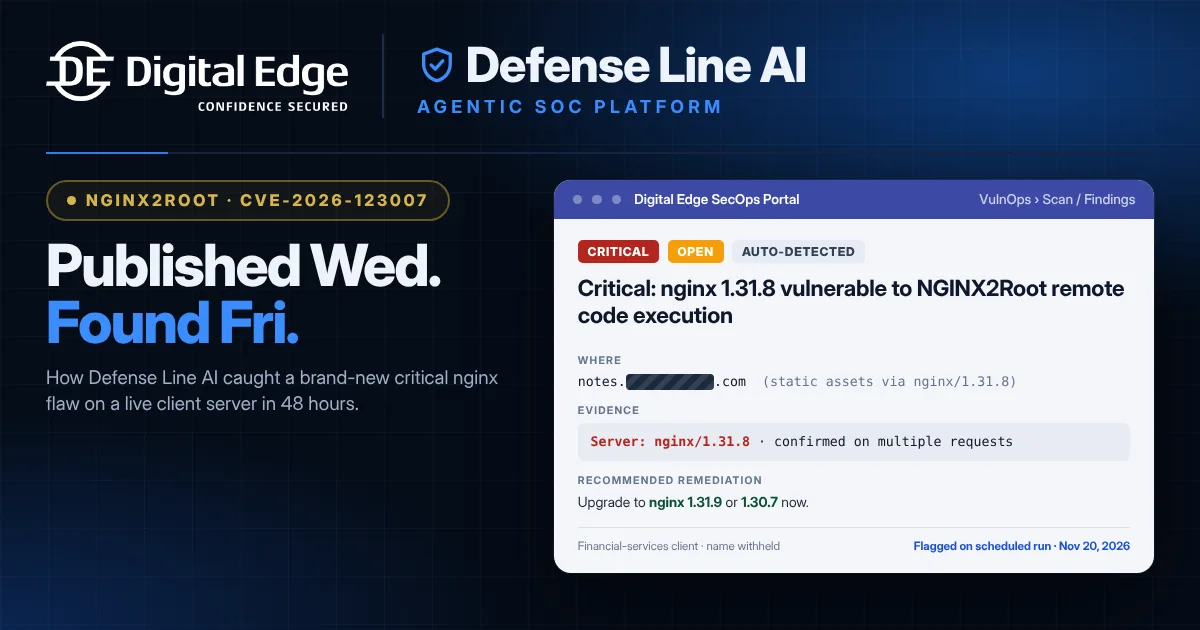
On November 20, two days after disclosure, DefenseLine AI flagged a critical finding at one of our financial-services clients: a static-content server running nginx 1.31.8, inside the vulnerable range.
Nobody on our team wrote a new detection rule, and nobody waited for a vendor's signature update. DefenseLine AI picked up the newly published vulnerabilities, built the test, and found the exposure on its next scheduled run. The two days were simply the run schedule. Clients can run these tests daily or hourly.
What the finding looked like
The result was not a bare risk score. It arrived in the Digital Edge SecOps Portal as a decision-ready finding:
- Where: the exact host, a static-asset server answering as nginx/1.31.8.
- What and why it matters: a plain-language summary of the five NGINX2Root flaws and the configurations that expose them.
- Evidence: the server's own response header, confirmed on multiple requests.
- Recommended fix: upgrade to nginx 1.31.9 or 1.30.7, coordinate with any CDN or load balancer in front, and review HTTP/2, HTTP/3, resolver and mail proxy exposure in the meantime.
Client names and hostnames are withheld, as always.
Why speed is now the whole game
For years, security teams had weeks between a vulnerability going public and attackers putting it to work. That buffer is gone. Industry trackers now put the average time from disclosure to exploitation at roughly a day, and AI tools are helping attackers build exploits faster still.
That changes the question leadership should ask. It is no longer "do we scan?" It is "how long after a critical flaw is published would we know, with proof, that it is in our environment, and how fast can we fix it?" A monthly or quarterly scan, or a tool that waits for its next content update, cannot answer that well.
How DefenseLine AI handles a new CVE
- Track. Newly published vulnerabilities are picked up automatically.
- Model. The platform builds the test for each new flaw.
- Test. It runs against the client's environment on the schedule the client chooses, from daily to hourly.
- Act. Evidence and the fix land in one portal, alongside MDR, endpoints, cloud posture, patch inventory and software inventory.
This is one capability inside a wider platform. DefenseLine AI also triages security alerts across cloud, identity, DevOps and endpoints. In a recent 24-hour production window it processed 36,098 alerts, closed 99.4% automatically with the reasoning logged, and escalated 4 to a human analyst. Every decision produces a compliance artifact.
Built and run by one in-house team
Many security products are sold through layers of distributors and resellers, and the people who find a problem are not the people who fix it. DefenseLine AI is different. Digital Edge engineers designed it, operate it and monitor client environments with it. When it flags a critical issue, the finding goes straight to a team that already knows the environment, can help patch it, and can document the fix for auditors. Digital Edge has done this since 1996 and holds ISO 27001, ISO 9001 and SOC 2 Type 2.
If you run nginx, do this now
- Find every nginx instance, including those bundled in appliances, containers and vendor products.
- Upgrade to nginx 1.31.9 or 1.30.7 (NGINX Plus: 37.0.8.1 or 37.3.0.1).
- If you cannot patch today, consider turning off HTTP/2 on exposed servers as a temporary measure, and review resolver and mail proxy use.
- Verify the running version after the upgrade, not just the installed package.
For another recent example of how we handle a critical disclosure, read our Java4Shell advisory. To see DefenseLine AI on your own environment, explore DefenseLine AI or book a 20-minute walk-through with the engineers who built it.