5 Best Penetration Testing Companies for Compliance-Driven Teams
Five pen testing firms compared on scope, retests, reports and who does the testing.
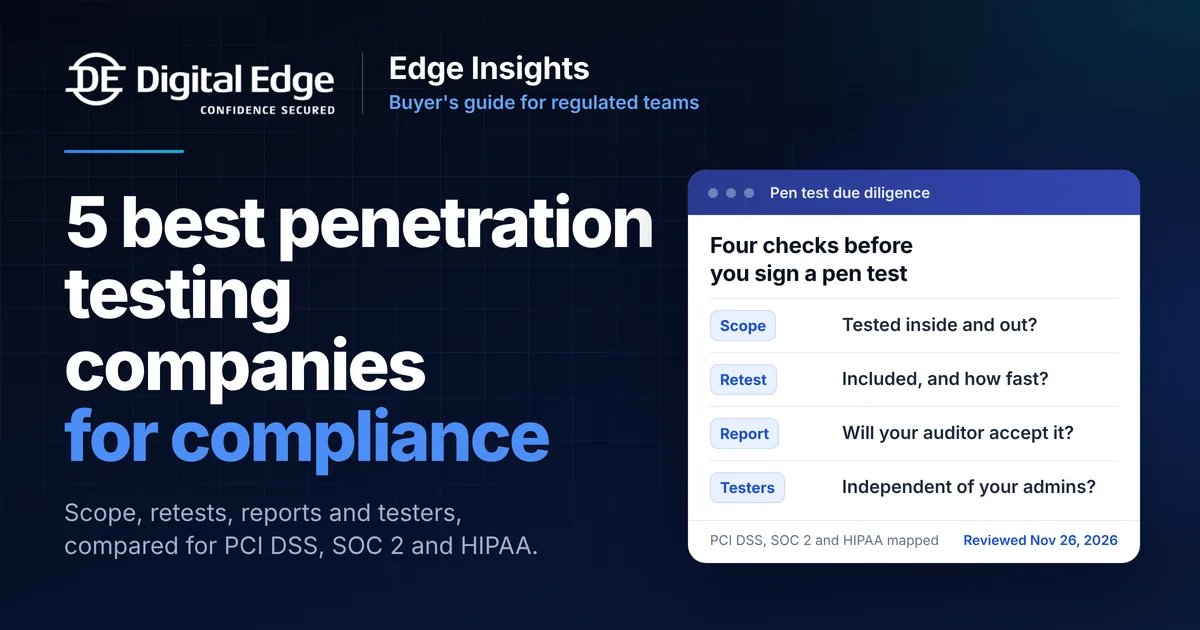
Five penetration testing companies compared for compliance-driven teams: what they test, how they retest and whether the report satisfies your auditor.
Choosing among penetration testing companies is a compliance decision as much as a security one: the test has to find real weaknesses, and the report has to hold up in front of a PCI DSS assessor, a SOC 2 auditor or a bank examiner.
- Digital Edge: best for regulated teams that want the test, the fixes and the audit evidence from one provider.
- Bishop Fox: best for complex, high-stakes environments that need deep manual testing and red team exercises.
- Cobalt: best for SaaS teams that test often. It publishes the clearest retest policy of the five: unlimited retesting during the contract, within a seven-day SLA.
- NetSPI: best for enterprises with many assets, including mainframes, that want a year-round testing program.
- Coalfire: best for organizations facing PCI DSS, FedRAMP or several audits at once.
- The rules: PCI DSS, NYDFS Part 500 and the GLBA Safeguards Rule expect at least one penetration test a year, and PCI DSS also requires a retest of exploitable findings. SOC 2 does not mandate one.
- Before you sign: ask any of these penetration testing companies for a redacted sample report, the retest terms in writing and how its testers stay independent of the systems they test.
This guide compares five penetration testing companies for compliance-driven teams in four categories: a managed security and compliance provider (Digital Edge), an offensive security specialist (Bishop Fox), two penetration testing as a service platforms (Cobalt and NetSPI) and a compliance-led assessor (Coalfire). Use it to decide on what actually matters for your audits: scope, retests, reports and who does the testing.
Why penetration testing is a compliance investment
Penetration testing is the part of a security program that auditors and customers can read. Several rules require it by name, and buyers ask for the report in security reviews. The most common failure is a mismatch between what was tested and what the rule asks for: an external-only test where NYDFS wants testing from inside and outside, an application test that leaves out the segmentation controls PCI DSS covers, or a findings list with no retest where PCI DSS requires one.
Here is what a penetration test should give a compliance-driven team:
- Scope that matches every framework you answer to, including segmentation controls and cloud accounts
- Findings with evidence, severity and a clear fix
- A retest that confirms the fixes, documented for the assessor
- A dated report your assessor or auditor can file, plus a summary letter for customers
- Testers who are qualified and independent of the systems they test
Four shifts make this more pressing:
- Exploits are still the top way in. Mandiant's M-Trends 2026, drawn from more than 500,000 hours of incident investigations in 2025, found exploits were the most common initial infection vector for the sixth year running, at 32% of intrusions where the vector was known, and estimated the mean time to exploit at minus seven days, meaning flaws are routinely exploited before a patch exists. The Verizon 2026 Data Breach Investigations Report, covering incidents from November 1, 2024 to October 31, 2025, found that 31% of breaches began with the exploitation of a vulnerability.
- Rules name the test. PCI DSS v4.0.1 requirement 11.4 calls for internal and external tests at least every 12 months and after significant changes, segmentation tests every 12 months (every six months for service providers) and a retest of exploitable findings. NYDFS Part 500 requires annual testing from inside and outside the information systems' boundaries, the FTC's Safeguards Rule requires an annual test unless you monitor continuously, and the EU's Digital Operational Resilience Act requires threat-led tests at least every three years for financial entities that authorities identify.
- Some frameworks do not require it, but buyers expect it. The AICPA's Trust Services Criteria name penetration testing only as an example of a separate evaluation under CC4.1, so SOC 2 does not mandate one. HIPAA's current rule asks for a periodic technical evaluation, and the January 2025 proposal to require a penetration test every 12 months had not been finalized at the time of this review.
- Testing is moving onto platforms, and AI is arriving. Platform providers now deliver findings in real time, retests on demand and attestation letters through a portal, and some offer AI-driven autonomous tests overseen by human testers. Ask how much of any AI output a qualified person has checked before it reaches your report.
How to evaluate penetration testing companies
Use these criteria to evaluate any penetration testing company, and apply them the same way to every provider so you compare like for like.
- Scope types: Does the standard scope cover internal and external networks, segmentation controls, cloud accounts, web applications and APIs, and people? Match it to each framework you answer to before you compare prices.
- Methodology: Does the provider follow a documented, industry-accepted method such as NIST SP 800-115 or the OWASP Web Security Testing Guide? PCI DSS requires a defined methodology, and assessors check it.
- Who does the testing: Employees or freelancers, and with which certifications? Check whether the firm appears in the CREST directory of accredited providers.
- Independence: PCI DSS requires testers who are organizationally independent of the systems they test, though they need not be a QSA or ASV. This matters when the same firm manages your environment or audits you.
- Retest policy: Is a retest included, how soon can you request it, does it cover the whole scope or only the fixes, and does it produce an updated report?
- Report format: Does the report show dates, scope, methodology, testers, findings with evidence and fixes, and retest results? The PCI Security Standards Council's 2017 penetration testing guidance, in its document library, includes suggested outlines for both test and retest reports.
- Attestation letters: Can you get a summary letter to share with customers without handing over the full report?
- Rules of engagement: How does the provider protect production systems, and can it work under strict access rules, such as staff-only changes in production?
- Remediation support: Can the provider help fix what it finds, or does the work stop at the report?
- Pricing transparency: What does the price include, such as retests, extra report versions and scope changes, and is the pricing model published?
Top penetration testing companies
Digital Edge: Best for regulated teams that want the test and the fixes from one provider
Digital Edge is a New York managed security and compliance provider that has served clients since 1996. Its in-house penetration testing team tests networks, cloud accounts, applications and people, then verifies fixes in a retest.
The defining difference: Digital Edge tests, helps fix and documents. Its testers work in the same company as its cloud operations, security operations and compliance teams, so a finding can move from the report to a fix and into your audit file without a hand-off to another vendor.
Key capabilities:
- External and internal network testing: open ports, services and segmentation, the routes attackers use first
- Cloud testing: configuration review and cloud-specific attack paths in AWS and Azure
- Web application testing: the OWASP Top 10 plus business logic testing
- Mobile application testing: iOS and Android apps and their APIs
- Social engineering: phishing simulations for staff
- Retesting: fixes confirmed and the report updated
- A clear timeline: scope and rules of engagement in the first week, testing across weeks one to three, then risk-ranked findings with remediation steps
- Remediation support: cloud operations and cloud security teams for AWS and Azure findings
- Compliance programs: vCISO leadership and programs for PCI DSS, SOC 2, HIPAA and NYDFS 500 that use the results
Best for: regulated SMBs and mid-market companies in financial services, health tech and SaaS that want the test, the fixes and the audit evidence handled by one team.
Limitations to know: Digital Edge does not publish a sample report, a list of tester certifications or pricing, so ask for all three. Its listed scope is narrower than the largest specialists: hardware, AI system and full red team engagements are not listed. If Digital Edge also manages the systems in scope, confirm that the testers are independent of the team that runs them, as PCI DSS requires of any tester.
Questions to ask on a Digital Edge demo:
- Can we see a redacted report and retest letter from a PCI DSS or SOC 2 engagement?
- Which certifications do the testers on our engagement hold?
- How are the testers kept independent of the team that manages our environment?
- How soon after we fix findings can the retest happen?
The compliance advantage
For a regulated company, the report is the start of more work: fixing findings, proving the fixes, updating the risk register and answering the auditor. Digital Edge runs that work in the same company that tested you, alongside 24×7 security operations and compliance programs, so you do not need separate vendors for testing, fixing and audit evidence.
It also works within the access rules regulated firms set. In a recent engagement for a regional bank with more than $18 billion in assets, Digital Edge ran controlled attack simulations, including ransomware, credential theft and lateral movement, under a policy that kept vendors out of production systems. The bank's own engineers executed every step while our team guided them.
Planning a test your auditor will accept?
Send us your framework and your last audit findings. In 30 minutes, a Digital Edge engineer will outline the scope, retest window and report your assessor or SOC 2 auditor will expect.
Digital Edge alternatives
The alternatives fall into three categories, each with different strengths and a different trade-off.
Offensive security specialist: Bishop Fox
Best for: complex, high-stakes environments that want deep manual testing and red team exercises.
Bishop Fox is an offensive security firm founded by ethical hackers, with more than 20 years of work behind it by its own account. It tests applications, AI systems, cloud environments, networks and hardware, runs red team exercises and offers Cosmos, a platform for continuous testing that routes findings through human validation.
Strengths:
- Breadth and depth: web and mobile applications, secure code review, AWS, GCP, Azure and Kubernetes, internal and external networks, hardware and AI or LLM testing, plus red teaming and social engineering
- Reports tailored to each audience, including compliance and executive versions, with weekly status reports and post-engagement reviews
- Research credibility: it builds widely used open-source offensive tools, including Sliver and CloudFox
Limitations:
- Retest terms are not stated on its penetration testing pages.
- No published pricing.
- It does not list compliance program services such as vCISO or audit preparation, so that work stays with your team or another provider.
Questions to ask on a demo:
- Is a retest included, and what document does it produce?
- Can we see a redacted compliance version of a report, as an assessor would receive it?
- Who will test our environment, and what are their qualifications?
Penetration testing as a service: Cobalt and NetSPI
Best for: SaaS and technology teams that test often (Cobalt), and enterprises with many assets that want a year-round program (NetSPI).
Both deliver testing through a platform rather than as one-off projects. Cobalt's tests are run by Cobalt Core, which it describes as a vetted community of freelance pentesters, and it now offers AI-driven autonomous tests alongside human-led ones. NetSPI's tests are delivered by more than 350 in-house pentesters, employed rather than outsourced, through The NetSPI Platform, which also covers attack surface management and breach and attack simulation.
Strengths:
- Cobalt has the clearest retest policy among the five: free, unlimited retesting throughout the contract term, delivered within a seven-day SLA according to its platform page
- Cobalt offers reports mapped to SOC 2, ISO 27001, HIPAA and PCI DSS, with attestation letters and executive summaries on demand, and publishes its pricing model: credits worth eight hours of testing each, sold in annual packages that include scoping, testing, retesting and platform access
- Cobalt tests can start within one to three business days, depending on the package, and an autonomous test runs in 24 hours under Cobalt Core oversight
- NetSPI covers unusual scope, including mainframes, virtual desktop breakout on Citrix and VMware, hardware, AI and ML systems and blockchain, and shows findings in live, interactive reports with ticketing integrations
Limitations:
- Cobalt's credit prices are quoted, not published, and unused credits do not roll over into the next contract year.
- Cobalt's testers are freelancers; ask who will work on your engagement and how your data is handled.
- An attestation letter summarizes a test, and your QSA or auditor may still ask for the full report.
- NetSPI does not state retest terms or pricing on its penetration testing pages, and platform-first delivery means you should confirm you will get a dated final report for your assessor.
Questions to ask on a demo:
- Will our assessor receive a dated, final report, or only platform findings and a letter?
- Who exactly will test our systems, employees or freelancers, and how are they vetted?
- How are AI-generated findings checked by a person before they reach the report?
Compliance-led assessor: Coalfire
Best for: organizations facing PCI DSS, FedRAMP or several audits at once that want testing timed to assessment deadlines.
Coalfire is a cybersecurity and compliance firm with more than 15 years as a PCI Qualified Security Assessor, FedRAMP assessment services and SOC 1, SOC 2 and SOC 3 reports. Its DivisionHex team handles offensive testing alongside defensive and managed services, and it offers PCI DSS and FedRAMP assessments that include penetration testing to validate controls.
Strengths:
- Testing planned around assessments, from a firm that also performs them
- Framework depth: it cites more than 600 framework experts and support for over 100 frameworks
- Offensive work beyond the annual test, including red teaming and social engineering
Limitations:
- Retesting depends on the package: its assessment packages range from "limited retesting included" to "expanded retesting options."
- If Coalfire is also your assessor, ask how it separates the testing team from the assessment team.
- No published pricing.
Questions to ask on a demo:
- How many retests does our package include, and within what window?
- How is the testing team kept independent of the team that assesses us?
- Can the test be scheduled so results and retests land before our assessment date?
Penetration testing comparison table
The table summarizes what each provider says about its own service. In-house testing is included because PCI DSS and NYDFS both allow qualified internal testers.
| Provider | Category | Best for | Who tests? | Retest | Report | Primary trade-off |
|---|---|---|---|---|---|---|
| Digital Edge | Managed security and compliance provider | Regulated SMBs and mid-market firms | In-house team | After fixes; report updated | Risk-ranked findings with fixes | Narrower scope; no sample report published |
| Bishop Fox | Offensive security specialist | Complex, high-stakes environments | Its own consultants | Not stated | Custom, incl. compliance versions | No compliance program services |
| Cobalt | Testing platform | SaaS teams that test often | Vetted freelancers | Unlimited, seven-day SLA | Platform reports; attestation letters | Freelance testers; prices quoted |
| NetSPI | Testing platform | Enterprises with year-round programs | 350+ in-house pentesters | Not stated | Live, interactive platform reports | Retest terms and pricing not public |
| Coalfire | Compliance-led assessor | Firms facing several audits | Offensive team beside its assessors | By package | Aligned with assessments | Independence questions if also your assessor |
| In-house team | Internal | Large firms with qualified staff | Your own testers | Your process | Your template | Must prove qualifications and independence |
Why choose Digital Edge
The providers in this guide fall into four kinds: offensive specialists, testing platforms, compliance-led assessors and providers that combine testing with operations. Digital Edge is in the last group.
- Testing, fixes and evidence in one company. The same company tests you, helps fix AWS and Azure findings through its cloud teams and keeps the results in your compliance program.
- Retests built in. Its engagements include a retest that confirms fixes and updates the report, which is the evidence PCI DSS requirement 11.4.4 asks for.
- Experience in regulated environments. Its attack simulations for a regional bank ran under a policy that kept vendors out of production, with the bank's engineers executing every step.
- Compliance programs that use the results. vCISO leadership and programs for PCI DSS, SOC 2, HIPAA and NYDFS 500.
- Certified management systems. Digital Edge holds ISO 27001:2022 and ISO 9001:2015 certifications.
The choice comes down to what happens after the test. If you have a security team ready to fix findings and a separate compliance function, a specialist or a platform may be all you need. If you want one team accountable from scope to retest to audit file, that is the work Digital Edge is built for.
Need the test and the fixes from one team?
Digital Edge tests your network, cloud and applications, retests what you fix and keeps the results in your audit file, with vCISO and compliance support behind the report.
Frequently asked questions about penetration testing
What is the difference between a penetration test and a vulnerability scan?
A vulnerability scan is automated and lists known weaknesses. A penetration test is carried out by people who try to exploit weaknesses and chain them together, the way an attacker would. PCI DSS treats them as separate obligations: quarterly scans under requirement 11.3 and penetration tests under requirement 11.4.
What is the most important question to ask a penetration testing company?
Ask what your auditor will receive: the scope, the methodology, the testers and their independence, the findings and the retest results. The answer tells you whether the test will count as evidence or lead to a second engagement.
How long does a penetration test take?
It depends on scope. Digital Edge scopes in the first week and tests across weeks one to three. Cobalt says its tests can start within one to three business days and that an autonomous test runs in 24 hours. Add time for fixes and the retest before your audit date.
How much does a penetration test cost?
None of the five providers here publishes prices. Cost depends on scope, the number of applications and IP addresses, and how much manual testing is needed. Cobalt publishes its model, credits worth eight hours of testing each, but quotes the price.
How often do compliance rules require a penetration test?
PCI DSS, NYDFS Part 500 and the GLBA Safeguards Rule all expect at least one test a year. PCI DSS adds tests after significant changes and segmentation tests every 12 months, or every six months for service providers. HIPAA's January 2025 proposal would add an annual test, but it is not final.
Does SOC 2 require a penetration test?
No. The Trust Services Criteria name penetration testing only as an example of a separate evaluation under CC4.1. Many auditors and enterprise customers still expect one, so most SOC 2 programs include an annual test.
Can our own team do the penetration test?
Yes, if they are qualified and independent. PCI DSS allows a qualified internal resource with organizational independence from the systems tested, and NYDFS Part 500 allows a qualified internal or external party. The hard part is proving both to your assessor.
How do I evaluate AI and autonomous testing claims?
Ask how a qualified person checks AI findings before they reach the report, which parts of the scope are tested by people, and whether assessors have accepted the provider's autonomous results as evidence for your framework.
Will Digital Edge work with our assessor or SOC 2 auditor?
Yes. Digital Edge's compliance team coordinates evidence requests with clients' auditors, and the test report and retest results go into that evidence.
Sources and review date
Reviewed November 26, 2026. The next review is due in May 2027. Provider facts come from each provider's own website, checked on the review date. No provider paid to be included, and we have not tested the other providers' services, so this guide compares what each one publishes about its service, not the quality of its work. We recheck provider facts every six months.
Regulations and standards: PCI DSS v4.0.1 and the PCI SSC penetration testing guidance; 23 NYCRR Part 500; 16 CFR 314.4; 45 CFR 164.308 and the proposed HIPAA Security Rule update; the AICPA Trust Services Criteria; Regulation (EU) 2022/2554 (DORA); NIST SP 800-115; the OWASP Web Security Testing Guide.
Studies: Mandiant, M-Trends 2026 (more than 500,000 hours of investigations in 2025); Verizon, 2026 Data Breach Investigations Report (incidents from November 1, 2024 to October 31, 2025).