5 Best SOC 2 Compliance Companies and Software
Managed services, automation software and audit firms compared, and when software alone is enough.
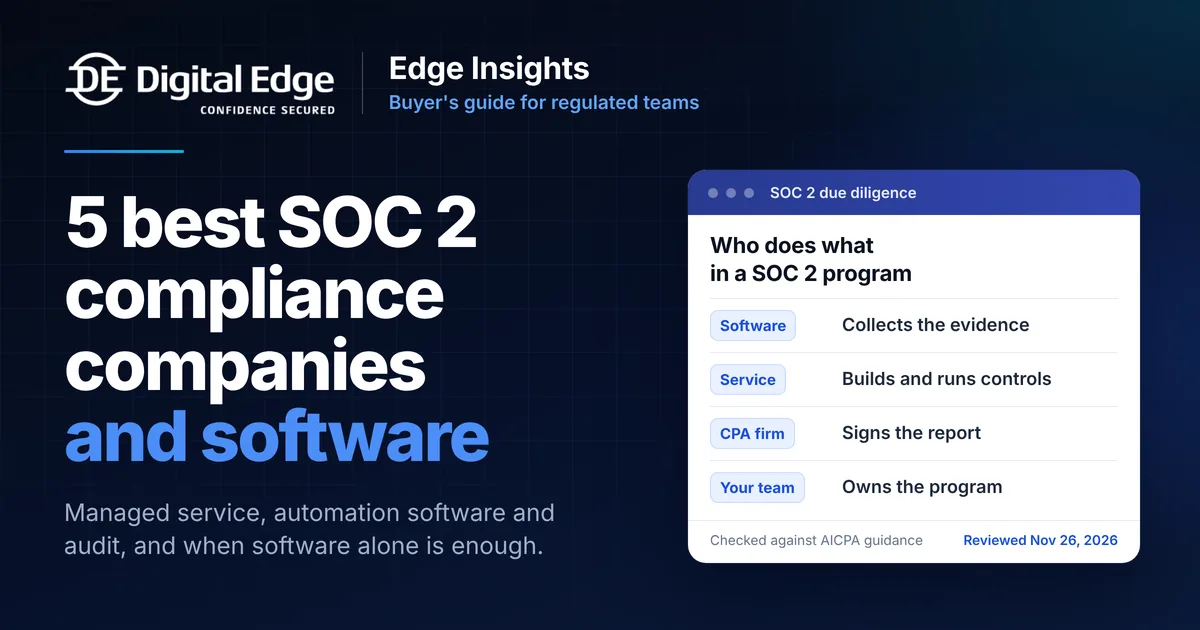
Five SOC 2 compliance companies compared for regulated teams: who builds the controls, who collects the evidence and who signs the report.
Choosing between SOC 2 compliance companies decides two things: whether enterprise and regulated buyers will sign, and how much of your team's time SOC 2 takes every year.
- Digital Edge: best for regulated teams that need SOC 2 run for them, with controls operated and evidence collected by its 24×7 SOC.
- Vanta: best for SaaS teams selling to security-conscious buyers, with 400+ integrations and a trust center.
- Drata: best for growth-stage SaaS teams with engineers to own the program. Its AWS Marketplace listing shows $25,000 a year for up to 100 employees.
- Secureframe: best for smaller teams that want expert guidance with the software. Plans start at $7,500 a year.
- Thoropass: best for teams on a deadline that want the software, the audit and a penetration test from one vendor.
- The rule that matters: only a licensed CPA firm can issue a SOC 2 report. Software and SOC 2 compliance companies get you ready; none of them can certify you.
- When software alone is enough: for a cloud-native team with someone who has time to own the program. Add people when nobody can run the controls or when HIPAA, PCI DSS or NYDFS rules also apply.
This guide compares the three kinds of SOC 2 compliance companies that buyers often confuse: managed services that build and run your controls, automation software that monitors them and collects evidence, and audit firms that issue the report. It covers Digital Edge (managed service), Drata, Secureframe and Vanta (automation software) and Thoropass (software with the audit built in). Only a licensed CPA firm can issue a SOC 2 report, so whichever you choose, check who will sign it.
Why SOC 2 is a strategic investment
A SOC 2 report is the document that lets a security review end with a signature. In our experience, the most common failure is treating it as a once-a-year project: evidence lives in screenshots, spreadsheets and email, controls drift between audits, and every report period starts with a scramble. A Type 2 report tests whether controls operated throughout a period, so a program that only works in audit season shows up as exceptions in the report.
Here is what a good SOC 2 program should produce:
- A report enterprise and regulated buyers accept, usually a Type 2
- Controls that run every day, not just before the audit
- Evidence collected as the work happens, ready when the auditor asks
- One set of controls mapped to SOC 2 and to the other frameworks you answer to
- An independent auditor and a report with few exceptions
Four shifts make this more pressing:
- Vendor reviews are getting stricter. NYDFS's October 2025 guidance on third-party service providers tells regulated firms to check whether a vendor undergoes external audits or independent assessments and to keep reviewing them during the relationship. The FTC's Safeguards Rule requires financial institutions to select service providers that can maintain appropriate safeguards and to assess them periodically. The Verizon 2026 Data Breach Investigations Report, covering incidents from November 1, 2024 to October 31, 2025, found a third party involved in 48% of breaches.
- Only a CPA firm can sign. SOC 2 belongs to the AICPA's System and Organization Controls suite, a set of services that CPAs provide on the controls of service organizations. Software can prepare you, but it cannot issue the report.
- Continuous monitoring is replacing the audit-season scramble. Automation platforms now connect to cloud, identity, HR and code systems and test controls continuously, some of them hourly, so failures surface between audits instead of during them.
- AI is entering compliance work. Vendors now use AI to draft policies, check evidence and suggest fixes, and at least one sells AI-assisted audits. Ask what the AI drafts and what a qualified person reviews before it reaches your auditor.
How to evaluate SOC 2 compliance companies
Use these criteria to evaluate any SOC 2 compliance company, and apply them the same way to every provider so you compare like for like.
- Who issues the report: Which CPA firm will sign it, and how many SOC 2 reports has its team issued? Ask for its latest peer review result.
- Who implements and operates the controls: Software monitors controls; people put them in place and run them. Decide who does that work before you compare prices.
- Integration coverage: Does the platform connect to every system in scope, including identity, HR, code and cloud? Systems outside the integrations mean manual evidence.
- Type 2 operations: Criteria CC7.2 to CC7.4 in the AICPA's Trust Services Criteria expect monitoring for anomalies and a working incident response program. Who will actually do that work during the review period?
- Evidence and auditor access: Can the auditor sample evidence and request documents inside the platform, or will your team export and email files?
- Multi-framework mapping: Can one set of controls also cover ISO 27001, HIPAA, PCI DSS or NYDFS Part 500 if your customers or regulators require them?
- Support model: Is expert help included, sold as an add-on or left to partners? Who is your named contact?
- Audit independence: The AICPA's Code of Professional Conduct limits the non-audit services a CPA firm can provide to the client it audits. If one company prepares you and audits you, ask how it keeps the two apart.
- Portability: What happens to your evidence, policies and history if you change platform or auditor?
- Pricing transparency: Is a price published, and does it include the audit, the penetration test, extra frameworks and implementation help?
Top SOC 2 compliance companies
Digital Edge: Best for regulated teams that need SOC 2 run for them
Digital Edge is a New York managed security and compliance provider that has served clients since 1996. Its SOC 2 service builds the controls, runs them every day and collects the evidence, then supports your CPA firm through the audit. Digital Edge does not issue SOC 2 reports; it can introduce audit partners.
The defining difference: software tells you a control failed, while Digital Edge runs the control. Its engineers operate identity, logging, EDR and backup controls, and its 24×7 security operations center produces monitoring and incident evidence for the Type 2 period.
Key capabilities:
- Scope and gap analysis: Trust Services Criteria in scope, systems, vendors and a gap report, in weeks one and two
- Control implementation: policies, access reviews, change management, logging, EDR, backup and vendor risk, built in weeks three to six
- 24×7 SOC evidence: monitoring with evidence captured daily for the Type 2 observation window
- Platform choice: its own CyberRegulator platform, Microsoft Purview, or the compliance automation platform you already use, run by its team
- Internal audits: independent testing of your controls before the external auditor arrives
- Audit support: auditor coordination, evidence requests and remediation of any exceptions
- Multi-framework mapping: one program mapped to ISO 27001, HIPAA, PCI DSS and NYDFS 500
- Program leadership: vCISO ownership of the program across frameworks
Best for: regulated SMBs and mid-market companies in financial services, health tech and SaaS that need SOC 2 alongside HIPAA, PCI DSS or NYDFS and do not have staff to run the controls.
Limitations to know: Digital Edge does not publish pricing, so you cannot compare it with software prices without a quote. You contract the CPA firm separately. Its timeline figures, such as a Type 1 in roughly four to eight weeks, are its own estimates and depend on your starting point.
Questions to ask on a Digital Edge demo:
- Which of our controls will your team operate, and which stay with us?
- Can you run the compliance platform we already pay for, or do we move to yours?
- What evidence does your SOC produce for the Type 2 period, and how does it reach the auditor?
- Which audit firms have you worked with, and how do you keep readiness work separate from the audit?
The operations advantage
A Type 2 report adds the auditor's opinion on whether controls operated effectively throughout a specified period, as the AICPA's Journal of Accountancy explains, and the AICPA's SOC 2 guide adds that it describes the auditor's tests of controls and their results. That makes operation, not documentation, the hard part. Digital Edge's controls run inside its own operations: alerts are handled by its 24×7 SOC, identity, logging and backup controls are run by its engineers, and the evidence is captured as the work happens. Its compliance team then maps the same evidence to every framework you answer to.
Not sure software alone will get you there?
Send us your stack and your target date. In 30 minutes, a Digital Edge compliance engineer will show which SOC 2 controls your tools can automate and which need people to run them.
Digital Edge alternatives
The alternatives fall into four categories, each with different strengths and a different trade-off.
Compliance automation platforms: Vanta and Drata
Best for: cloud-native SaaS companies with someone who has the time to own the program and fix what the platform flags.
Both connect to your cloud, identity, HR, code and device tools, test controls continuously and collect evidence for the audit. Vanta connects to more than 400 tools, runs tests hourly and adds an AI agent that reviews evidence and suggests fixes. Drata maps evidence to SOC 2 controls automatically, tests controls across all five Trust Services categories and reuses evidence from one audit period to the next.
Strengths:
- Continuous testing that surfaces failing controls between audits
- Auditor access in the platform: Vanta works with more than 100 auditors directly or through its API, and Drata's Audit Hub lets auditors pick samples and request documents
- Features that speed sales, such as Vanta's trust center and AI-assisted questionnaire answers
- Auditor-approved policy templates and support for many frameworks beyond SOC 2
Limitations:
- They are software: your team still implements controls, fixes failing tests and engages a CPA firm.
- Vanta does not publish prices. Drata's own AWS Marketplace listing prices platform access at $25,000 for 12 months for up to 100 employees, with frameworks and modules added as separate units.
- Vanta's estimates of how much SOC 2 work carries over to other frameworks, such as 80% for ISO 27001 and 40% for HIPAA, are its own figures.
Questions to ask on a demo:
- Which of our systems fall outside your integrations, and how is their evidence collected?
- What does the full first-year cost include: frameworks, auditor, penetration test, implementation help?
- Who fixes a failing test, and how fast does the platform expect it?
Automation with expert guidance: Secureframe
Best for: small and mid-size companies that want a published starting price and expert guidance with the software.
Secureframe pairs a compliance automation platform with in-house compliance experts. It monitors your cloud through more than 150 integrations and guides you through readiness and the audit, which comes from a firm in its audit partner network.
Strengths:
- A published entry price: the Fundamentals package starts at $7,500 a year
- Policies written by in-house security experts and former auditors, and dedicated audit support
- Built-in tasks beyond monitoring, including security awareness training, vendor risk, device monitoring through its agent and AI help with policies and remediation
Limitations:
- The starting price covers the entry package; larger programs move to quoted pricing.
- Controls are still yours to implement and operate.
Questions to ask on a demo:
- What exactly does the $7,500 package include, and what moves us to the next tier?
- Who is our named compliance expert, and how much of their time is included?
- Which audit partners do your customers use, and what do they charge?
Software with the audit built in: Thoropass
Best for: companies on a deadline that want software, the audit and a penetration test from one vendor.
Thoropass combines a compliance platform with the audit. Its SOC 2 audits are performed by in-house auditors through its Audit Lifecycle Platform, and it states that its affiliate, Laika Compliance, LLC, doing business as Thoropass Assurance, is a licensed CPA firm registered with the AICPA. It says it serves more than 2,000 organizations.
Strengths:
- One vendor from readiness to report, which removes the hand-off between a software company and a separate audit firm
- Penetration testing by CREST-accredited testers and vulnerability scanning in the same platform
- Coverage beyond SOC 2, including ISO 27001, PCI DSS, HITRUST and HIPAA
Limitations:
- Because one company prepares and audits you, read how it keeps the audit independent; it publishes a statement on the subject.
- Pricing is quoted and reflects both software and audit.
- Controls are still yours to implement and operate.
Questions to ask on a demo:
- How are the people who advise us separated from the auditors who test us?
- What happens to our evidence and history if we later move to another audit firm?
- What does the quote include for the audit, the penetration test and extra frameworks?
Independent CPA audit firms
Best for: companies that already run their controls well and need a report that buyers will trust.
Every SOC 2 report is issued by a CPA firm, so this category is part of every option above. Some teams also hire an audit firm directly and choose their own software or service for readiness, which keeps the two roles fully separate.
Strengths:
- Clear independence between the people who prepared you and the people who test you
- Free choice of firm, by industry experience, reputation with your buyers and price
Limitations:
- Independence rules limit how much a firm can help design or run the controls it audits, so readiness work comes from elsewhere.
- You coordinate the hand-off between your readiness tools and the auditor yourself.
Questions to ask on a demo:
- How many SOC 2 reports has your team signed, and in our industry?
- What was your latest peer review result?
- Which compliance platforms do you work in, and what do Type 1 and Type 2 cost?
SOC 2 compliance comparison table
The table summarizes what each provider says about its own service. A do-it-yourself row is included because some early teams start there.
| Provider | Category | Best for | Who runs the controls? | Who issues the report? | Pricing | Primary trade-off |
|---|---|---|---|---|---|---|
| Digital Edge | Managed service | Regulated teams without staff to run SOC 2 | Digital Edge, with your team | An independent CPA firm | Not published | Higher-touch service; CPA firm contracted separately |
| Vanta | Automation software | SaaS teams selling to security-conscious buyers | Your team | A firm from its auditor network | Quote | Implementation stays with you |
| Drata | Automation software | Growth-stage SaaS with engineers to spare | Your team | A CPA firm you choose | $25,000 a year platform fee for up to 100 employees | Frameworks and modules priced separately |
| Secureframe | Software with expert guidance | Smaller teams that want guidance | Your team, with guidance | A firm from its partner network | From $7,500 a year | Larger programs move to quotes |
| Thoropass | Software and audit | Teams on a deadline | Your team | Its affiliated CPA firm | Quote | Independence questions when one firm prepares and audits |
| Independent CPA firm | Audit firm | Teams whose controls already run well | Your team | The firm itself | Quote | Readiness work comes from elsewhere |
| Spreadsheets and in-house | Do it yourself | Very early teams, short term only | Your team | A CPA firm you choose | Staff time | Manual evidence; depends on one or two people |
Why choose Digital Edge for SOC 2
The providers in this guide fall into three kinds: software that monitors controls, audit firms that test them, and services that run them. Digital Edge is in the last group.
- Controls built and operated. Its engineers put identity, logging, EDR and backup controls in place and run them, instead of leaving failing tests on your team's list.
- Evidence from real operations. Its 24×7 SOC handles alerts and incidents, so the monitoring and response criteria have evidence behind them for the whole review period.
- Your platform or ours. It runs CyberRegulator, Microsoft Purview or the automation platform you already pay for.
- One program, several frameworks. The same controls map to ISO 27001, HIPAA, PCI DSS and NYDFS 500, with internal audits before the external one.
- Certified management systems. Digital Edge holds ISO 27001:2022 and ISO 9001:2015 certifications and has an in-house legal and compliance team.
The choice comes down to who will do the work between audits. If your team has the time to own the program, software and an auditor may be all you need. If you want the controls run for you and the evidence collected as a by-product of operations, that is the work Digital Edge is built for.
SOC 2 run for you, every day
Digital Edge builds the controls, operates them with its 24×7 SOC and collects the evidence daily, then supports your CPA firm through the audit.
Frequently asked questions about SOC 2 compliance
What is the difference between SOC 2 software and a SOC 2 compliance service?
SOC 2 software connects to your systems, tests controls and collects evidence, but your team puts the controls in place and runs them. A SOC 2 compliance service does that work for you. Neither issues the report; a licensed CPA firm does.
What is the most important question to ask a SOC 2 compliance company?
Ask who will run the controls during the review period and who will sign the report. The first answer tells you how much work stays with your team; the second tells you whether the report will be independent.
Is SOC 2 software enough on its own?
Sometimes. It is usually enough for a cloud-native team with someone who has time to own the program. It falls short when nobody can implement controls, when systems sit outside the platform's integrations, or when HIPAA, PCI DSS or NYDFS rules apply as well.
How long does SOC 2 take?
It depends on your starting point. Digital Edge estimates roughly four to eight weeks to be ready for a Type 1. A Type 2 then needs your controls to operate through a review period agreed with your auditor before the report can be issued.
How much does SOC 2 compliance software cost?
Most vendors quote on request. Among those in this guide, Secureframe's entry package starts at $7,500 a year, and Drata's AWS Marketplace listing shows a $25,000 annual platform fee for up to 100 employees before framework add-ons. The CPA audit, penetration test and any implementation help usually cost extra.
What is the difference between a SOC 2 Type 1 and Type 2 report?
A Type 1 report covers the design of your controls on a single date. A Type 2 report also tests whether they operated effectively over a review period, which, in our experience, is what most enterprise buyers ask for.
Can SOC 2 software get us certified?
No. SOC 2 is an attestation report, not a certification, and only a licensed CPA firm can issue it. Software gets you ready and makes the audit faster.
How do I evaluate AI claims from SOC 2 vendors?
Ask what the AI produces, such as draft policies, evidence checks or suggested fixes, and what a qualified person reviews before it reaches your auditor. Then ask the auditor whether it has accepted that output from other clients.
Will Digital Edge work with our existing compliance software and auditor?
Yes. Digital Edge runs the compliance automation platform you already use or its own CyberRegulator platform, and it supports your CPA firm with auditor coordination and evidence requests. It can also introduce audit partners.
Does a SOC 2 report cover HIPAA or NYDFS requirements?
No. Many controls overlap, and platforms can map them across frameworks, but HIPAA and NYDFS Part 500 each have their own requirements, which SOC 2 does not replace.
Sources and review date
Reviewed November 26, 2026. The next review is due in May 2027. Provider facts come from each provider's own website, checked on the review date. No provider paid to be included, and we have not tested the other providers' services, so this guide compares what each one publishes about its service, not the quality of its work. We recheck provider facts every six months.
Standards and rules: the AICPA's SOC suite of services, Trust Services Criteria and Code of Professional Conduct; the Journal of Accountancy on SOC report types; the NYDFS industry letter of October 21, 2025; and the FTC's Safeguards Rule.
Study: Verizon, 2026 Data Breach Investigations Report (incidents from November 1, 2024 to October 31, 2025).