5 Best HIPAA Compliance Companies for Healthtech
Managed programs, risk specialists and software compared on the risk analysis and audit evidence.
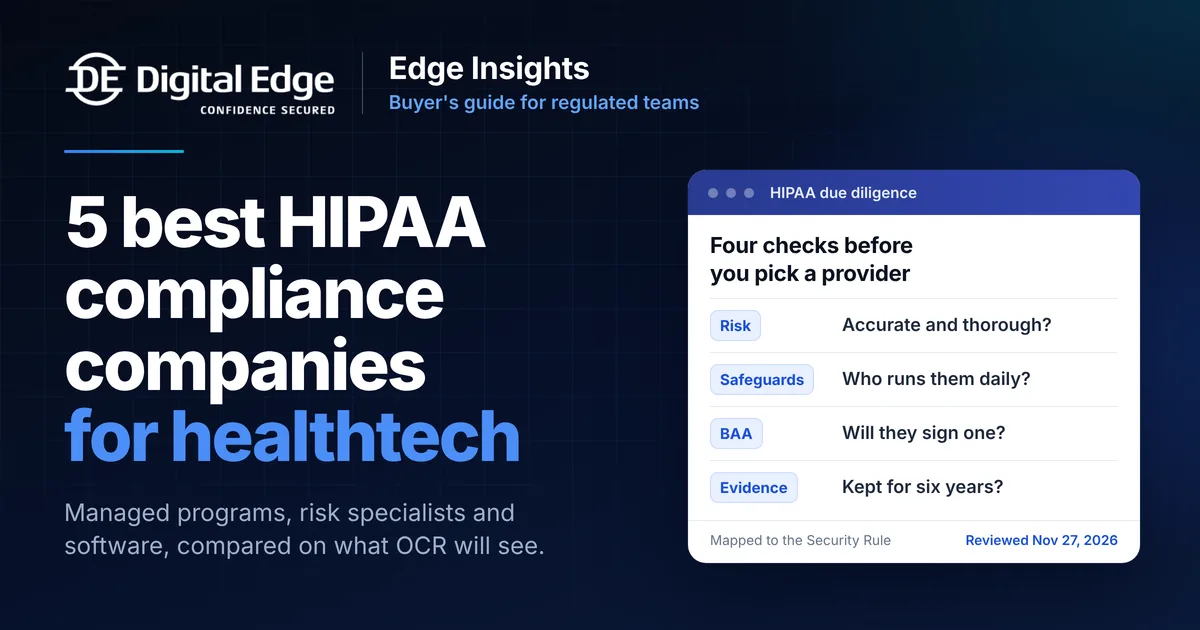
Five HIPAA compliance companies compared for health tech and healthcare teams: who does the risk analysis, who runs the safeguards and what OCR will see.
Choosing among HIPAA compliance companies comes down to one document that OCR keeps asking for: an accurate and thorough risk analysis, and the evidence that you acted on it.
- Digital Edge: best for health tech and healthcare teams that want HIPAA safeguards run for them, with a signed BAA and 24×7 monitoring evidence.
- Clearwater: best for hospitals, health systems and larger digital health companies that want healthcare-specialist risk analysis, with managed security available.
- Intraprise Health: best for organizations that run many risk assessments and want software to standardize them, with vCISO and HITRUST help on hand.
- Compliancy Group: best for practices and smaller vendors that want guided compliance software with coaching.
- Vanta: best for health tech SaaS companies acting as business associates that want automated evidence alongside SOC 2.
- The rule that matters: there is no official HIPAA certification. HHS does not recognize private "certifications," and none of them protects you from an OCR finding.
- What OCR focuses on: the risk analysis. OCR's June 2026 settlement with a health plan was the 14th enforcement action in its Risk Analysis Initiative.
This guide compares five HIPAA compliance companies for health tech and healthcare teams in three categories: a managed program that runs your safeguards (Digital Edge), healthcare risk specialists that combine consulting and software (Clearwater and Intraprise Health), and compliance software (Compliancy Group and Vanta). For each one, it shows what you actually get for the risk analysis and for the audit evidence that OCR, hospital customers and auditors ask for.
Why HIPAA compliance is a strategic investment
For a health tech company, HIPAA compliance is what lets a hospital or health plan send you patient data. For a provider, it is what keeps a breach from turning into a federal investigation with a multi-year corrective action plan. Both depend on the same foundation. The Security Rule requires covered entities and business associates to conduct an accurate and thorough assessment of the potential risks and vulnerabilities to the confidentiality, integrity and availability of electronic protected health information (ePHI), then implement security measures that reduce those risks to a reasonable and appropriate level.
In our experience, the most common failure is treating that analysis as a one-time document: a template filled in once, stored in a folder and never connected to the systems that actually hold patient data. OCR's recent breach settlements center on the risk analysis, and an outdated one is hard to defend.
Here is what a good HIPAA program should produce:
- A risk analysis that covers every system that creates, receives, maintains or transmits ePHI, and is updated when those systems change
- A risk management plan that shows which risks were reduced, how and when
- Signed business associate agreements with every vendor that handles PHI
- Policies, training records, activity reviews and incident records kept for six years, as the documentation standard requires
- A breach response that can meet the 60-day notification limits
- Evidence that hospital and payer customers accept in their security reviews
Four shifts make this more pressing:
- OCR is enforcing the risk analysis. HHS created its Risk Analysis Initiative to focus investigations on the Security Rule's risk analysis provision, which it calls the foundation for effective cybersecurity and the protection of ePHI. In June 2026, OCR announced a settlement with a health plan that paid $450,000 and accepted a two-year corrective action plan, the initiative's 14th enforcement action and OCR's 20th in a ransomware case.
- Healthcare breaches remain the most expensive. The IBM Cost of a Data Breach Report 2026, research by the Ponemon Institute across 602 breached organizations between March 2025 and February 2026, put the average healthcare breach at $6.64 million, the highest of 17 industries for the 13th year running. Healthcare breaches took an average of 220 days to identify and 72 days to contain.
- The Security Rule may get stricter, but not yet. HHS's January 2025 proposal would add requirements such as an annual penetration test, vulnerability scans every six months and a risk analysis reviewed at least every 12 months. The federal regulatory agenda now lists final action for July 2027, and the current rule applies until then.
- Twelve months of good practice now count. Public Law 116-321, signed January 5, 2021, requires HHS to consider whether an organization can show that it had recognized security practices, such as the NIST Cybersecurity Framework or the 405(d) Health Industry Cybersecurity Practices, in place for at least the previous 12 months when it sets fines, ends audits or agrees remedies. That rewards a program that runs all year and keeps evidence of it.
How to evaluate HIPAA compliance companies
Use these criteria to evaluate any HIPAA compliance company, and apply them the same way to every provider so you compare like for like.
- Risk analysis method: Does the analysis cover every system that holds ePHI, including cloud services, laptops and medical devices, and rate the likelihood and impact of each threat? HHS's risk analysis guidance and NIST's SP 800-66 Revision 2 (February 2024) describe what OCR expects.
- Risk management, not just the assessment: Who reduces the risks the analysis finds, and who documents what was done? The Security Rule requires both steps.
- Who does the work: Software you run yourself, consultants who advise you, or a team that operates the safeguards? Each leaves a different amount of work with your staff.
- Business associate agreement: Will the provider sign a BAA if it can access ePHI? Under HIPAA's definitions, a vendor that handles PHI on your behalf is a business associate.
- Evidence and retention: Will policies, assessments, training records and activity reviews be kept, and retrievable, for six years?
- Monitoring and incident response: The Security Rule requires regular review of system activity, such as audit logs and access reports, and procedures to identify, respond to and document security incidents. Who will do that work?
- Breach notification readiness: Can the provider help you meet the Breach Notification Rule deadlines, which allow no more than 60 calendar days after discovery?
- Recognized security practices: Can the program show 12 months of NIST Cybersecurity Framework or 405(d) practices in operation, the period Public Law 116-321 refers to?
- Certification claims: HHS does not endorse or recognize private organizations' HIPAA "certifications." Ask what any seal or certificate actually checks.
- Pricing transparency: Is a price published, and does it include the risk analysis, remediation, training, BAA management and help during an OCR inquiry?
Top HIPAA compliance companies
Digital Edge: Best for health tech and healthcare teams that want HIPAA safeguards run for them
Digital Edge is a New York managed security and compliance provider that has served clients since 1996. Its HIPAA program starts with a security risk analysis, puts safeguards and business associate agreements in place, monitors and responds around the clock and repeats an internal audit every year.
The defining difference: Digital Edge runs the safeguards and documents them. Its engineers operate access controls, encryption, logging and backup, its 24×7 security operations center reviews activity and responds to incidents, and its compliance team keeps the evidence for regulators, customers and HITRUST assessors. Digital Edge signs business associate agreements and operates as a HIPAA business associate.
Key capabilities:
- Security risk analysis: where ePHI lives, who can reach it and the risks that matter most
- Safeguards and BAAs: policies, workforce training, access controls, encryption, logging and business associate agreements
- Monitoring and response: 24×7 detection and response, incident response plans and breach notification readiness
- Yearly internal audit: HIPAA reviews and HITRUST internal audits
- HITRUST support: readiness, internal audits and the evidence HITRUST assessors request
- SOC 2 and HIPAA together: one program for health tech platforms that sell to providers and payers
- Email, data and recovery: Microsoft 365 hardening where PHI travels, encryption and data governance, and backup and disaster recovery for clinical systems
- Compliance platform: its own CyberRegulator platform, Microsoft Purview or the platform you already use
Best for: health tech companies, providers and other business associates that need HIPAA, often with SOC 2 or HITRUST, and do not have a security team to run the safeguards.
Limitations to know: Digital Edge does not publish pricing. It works across regulated industries rather than healthcare alone, so ask for healthcare references. Its estimate of a 30 to 45 day baseline is its own and depends on your starting point.
Questions to ask on a Digital Edge demo:
- Can we see a redacted risk analysis and risk management plan from a health tech client?
- Which safeguards will your team operate, and which stay with us?
- How does your SOC's evidence map to the Security Rule's activity review and incident procedures?
- Does your BAA cover the subcontractors you use?
The operations advantage
OCR's Risk Analysis Initiative settlements typically end in a corrective action plan, monitored for two or three years, that starts with an accurate and thorough risk analysis and usually adds a risk management plan, policy updates and training. Each of those is work that has to keep running after the paperwork is done. Digital Edge runs it as part of operations: the same team that maintains your systems keeps the risk analysis current, the SOC produces the activity review and incident records the Security Rule asks for, and the evidence builds up month by month, which is also what Public Law 116-321 asks organizations to demonstrate.
Is your HIPAA risk analysis ready for OCR?
Send us your last risk analysis or your system list. In 30 minutes, a Digital Edge compliance engineer will show where it falls short of an accurate and thorough analysis and what to fix first.
Digital Edge alternatives
The alternatives fall into three categories, each with different strengths and a different trade-off.
Healthcare risk specialists: Clearwater and Intraprise Health
Best for: hospitals, health systems and larger digital health companies that want healthcare-specialist risk analysis (Clearwater), and organizations that run many assessments across entities and want software to standardize them (Intraprise Health).
Both focus on healthcare and combine consulting with their own software. Clearwater offers what it calls an OCR-Quality® Risk Analysis, which it says hundreds of healthcare organizations use, supported by its IRM software suite. It also runs a healthcare-focused managed security service with 24/7 threat detection and response, and audit services for HITRUST, SOC 2 and PCI DSS. Intraprise Health sells HIPAA One™, cloud software for annual security risk assessments, privacy and breach risk assessments, workforce training and business associate tracking, alongside vCISO, remediation and HITRUST services. It says it serves more than 10,000 healthcare organizations.
Strengths:
- Deep healthcare focus, including medical device security and 405(d) assessments at Clearwater
- Risk analysis methods built specifically around the Security Rule and OCR's expectations
- Software that keeps assessments in one place: Clearwater's IRM suite and Intraprise Health's HIPAA One, which can populate assessments for sub-entities
- Services beyond the assessment, including vCISOs at both and managed security at Clearwater
Limitations:
- Neither publishes pricing.
- Assessment software guides your team through the analysis, but the remediation work stays with you unless you buy services.
- Intraprise Health acts as a HITRUST assessor and also sells advisory services; if it assesses you, ask how it keeps the assessment independent of the advice.
Questions to ask on a demo:
- Can we see a redacted risk analysis report and the risk management plan that followed it?
- Does the analysis cover every system with ePHI, including cloud services and medical devices?
- Who updates the analysis when our systems change, and how is that recorded?
Compliance software with coaching: Compliancy Group
Best for: physician practices, dental offices and smaller vendors that want guided software and someone to call.
Compliancy Group sells The Guard, a healthcare compliance platform for organizations from startups to large providers, including SaaS vendors and MSPs. It combines more than 100 policy templates, training for HIPAA, OSHA and fraud, waste and abuse, risk assessments, incident reporting, vendor due diligence and business associate agreements, checks against 55 exclusion lists and an AI assistant called CORA. Advisory services are available, and onboarding ranges from self-serve to one-on-one support.
Strengths:
- Built for organizations without a compliance department, with question-by-question risk assessments
- Broad healthcare compliance beyond HIPAA, including OSHA training and exclusion list checks
- Ongoing customer success support after onboarding
Limitations:
- Pricing is available only on request.
- The software organizes and guides the work; technical safeguards such as logging and monitoring stay with your staff or IT provider.
- Its Audit Response Program is a paid add-on, and its terms state it does not include consulting, legal or auditing services, so read them before relying on it in an OCR inquiry.
Questions to ask on a demo:
- How does the risk assessment reflect our actual systems, not just our answers to a questionnaire?
- What exactly does the Audit Response Program do if OCR contacts us?
- Which onboarding package do we need, and what does it cost?
Automation platform for health tech: Vanta
Best for: health tech SaaS companies acting as business associates, especially those that already run SOC 2.
Vanta helps business associates meet HIPAA Security Rule and Breach Notification Rule requirements with automated evidence, guided controls and continuous monitoring. It turns HIPAA requirements into controls, policies and tests, scopes them to the systems that actually handle PHI and pulls evidence from more than 400 integrations.
Strengths:
- Automated evidence collection and continuous testing across cloud, identity, code and device tools
- Scoping that limits HIPAA controls to the systems that handle PHI, plus asset inventory and user access tracking
- HIPAA-ready policy templates, built-in HIPAA training and a trust center for sharing your posture with customers
Limitations:
- No published pricing; Vanta builds a quote after a demo.
- Your team still implements controls and owns the risk analysis decisions.
- Its estimates of how much HIPAA work carries over to other frameworks, such as 40% for SOC 2, are its own figures.
Questions to ask on a demo:
- How are systems outside your integrations, such as an EHR or practice management system, covered?
- What does the risk analysis look like in the platform, and will OCR see it as accurate and thorough?
- What does the first year cost with HIPAA and SOC 2 together?
HIPAA compliance comparison table
The table summarizes what each provider says about its own service. The free HHS Security Risk Assessment Tool is included because many small practices start there.
| Provider | Category | Best for | Risk analysis | Who runs safeguards? | Pricing | Primary trade-off |
|---|---|---|---|---|---|---|
| Digital Edge | Managed program | Health tech and providers without a security team | Done by its team and updated through operations | Digital Edge, with your team | Not published | Not healthcare-only; quote required |
| Clearwater | Healthcare risk specialist | Hospitals, health systems and digital health | Consultant-led, with IRM software | Your team, or its managed services | Not published | Consulting and managed security sold separately |
| Intraprise Health | Assessment software and services | Organizations with many assessments | Software-guided, with expert support | Your team | Not published | Remediation stays with you unless you add services |
| Compliancy Group | Compliance software with coaching | Practices and smaller vendors | Guided questionnaires in the platform | Your team | On request | Guidance, not operation of technical controls |
| Vanta | Automation platform | Health tech SaaS business associates | Platform workflows with automated evidence | Your team | Quote | Built around technology stacks |
| HHS SRA Tool | Free government tool | Small and medium providers | Self-guided wizard, version 3.7 | Your team | Free | No help with remediation; may not suit large organizations |
The SRA Tool, from ONC and OCR, is a free Windows application and Excel workbook first released in 2014; version 3.7 arrived in September 2026. ONC aims it at small and medium providers and notes that using it neither is required nor guarantees compliance.
Why choose Digital Edge for HIPAA
The providers in this guide fall into three kinds: software that guides or automates the work, specialists that assess and advise, and a managed program that runs the safeguards. Digital Edge is in the last group.
- Safeguards operated, not just documented. Its engineers run access controls, encryption, logging and backup, so the risk management plan is carried out, not just written.
- Activity review and incident response covered. Its 24×7 SOC reviews activity and handles incidents, producing the records the Security Rule requires.
- A signed BAA. Digital Edge signs business associate agreements and operates as a HIPAA business associate.
- One program for HIPAA, HITRUST and SOC 2. Health tech companies selling to providers and payers can answer all three with the same controls, with an internal audit every year.
- Certified management systems. Digital Edge holds ISO 27001:2022 and ISO 9001:2015 certifications.
The choice comes down to who will run the program between assessments. If you have staff to carry out the risk management plan, software or a specialist assessment may be enough. If you want the safeguards run for you and the evidence kept as a by-product of operations, that is the work Digital Edge is built for.
HIPAA safeguards, run for you
Digital Edge runs the risk analysis, operates the safeguards with its 24×7 SOC, signs your BAA and keeps the evidence ready for OCR, hospital customers and HITRUST assessors.
Frequently asked questions about HIPAA compliance
What is the difference between HIPAA compliance software and a HIPAA compliance service?
Software organizes the work: policies, risk assessments, training and evidence. A service does some of the work for you, from consulting on the risk analysis to running the safeguards. Either way, your organization stays responsible for compliance.
Is there an official HIPAA certification?
No. HHS states that no standard requires you to certify compliance, that it does not endorse or recognize private organizations' certifications, and that a certification does not prevent it from later finding a violation. HITRUST certification and SOC 2 reports are useful evidence for customers, but they are not HIPAA certifications.
What is a HIPAA risk analysis, and how often is it needed?
It is an accurate and thorough assessment of the risks to the confidentiality, integrity and availability of your ePHI. The current rule does not set a fixed interval, but it requires periodic evaluation and updates when your environment changes. HHS's January 2025 proposal would require a review at least every 12 months.
Do health tech companies have to comply with HIPAA?
Yes, if they create, receive, maintain or transmit PHI on behalf of a covered entity such as a provider or health plan. That makes them a business associate, bound by the Security Rule and by the business associate agreement they sign.
What does OCR focus on after a breach?
In recent settlements, the risk analysis. OCR's Risk Analysis Initiative targets that requirement, and its corrective action plans typically begin with a new, accurate and thorough risk analysis and a risk management plan.
How much do HIPAA compliance companies cost?
None of the five providers here publishes prices. Cost depends on the number of locations and systems, whether you need software, consulting or managed safeguards, and extras such as HITRUST or SOC 2. The HHS SRA Tool is free.
Is the free HHS SRA Tool enough?
For a small or medium practice, it can produce a usable risk analysis if someone puts in the time and keeps it current. ONC notes that it may not suit larger organizations, and the tool does not carry out the risk management work for you.
How fast must we report a HIPAA breach?
Individuals must be notified without unreasonable delay and no later than 60 calendar days after discovery. Breaches affecting 500 or more people must also be reported to HHS at the same time, and to the media if more than 500 residents of a state are affected. Business associates must notify the covered entity within the same 60-day limit.
Will Digital Edge sign a business associate agreement?
Yes. Digital Edge signs business associate agreements and operates as a HIPAA business associate.
Sources and review date
Reviewed November 27, 2026. The next review is due in May 2027. Provider facts come from each provider's own website, checked on the review date. No provider paid to be included, and we have not tested the other providers' services, so this guide compares what each one publishes about its service, not the quality of its work. We recheck provider facts every six months.
Regulations and guidance: 45 CFR 164.308, 164.316 and the Breach Notification Rule; 45 CFR 160.103; HHS's risk analysis guidance and FAQ on certification; the proposed Security Rule update; Public Law 116-321; NIST SP 800-66 Revision 2; the 405(d) program; the SRA Tool; and OCR's Risk Analysis Initiative announcements from 2025 and June 2026.
Study: IBM and the Ponemon Institute, Cost of a Data Breach Report 2026 (602 organizations, breaches from March 2025 to February 2026).