5 Best MDR Providers for Regulated Companies
Five services compared on who acts on an alert, what evidence your auditor gets and how pricing works.
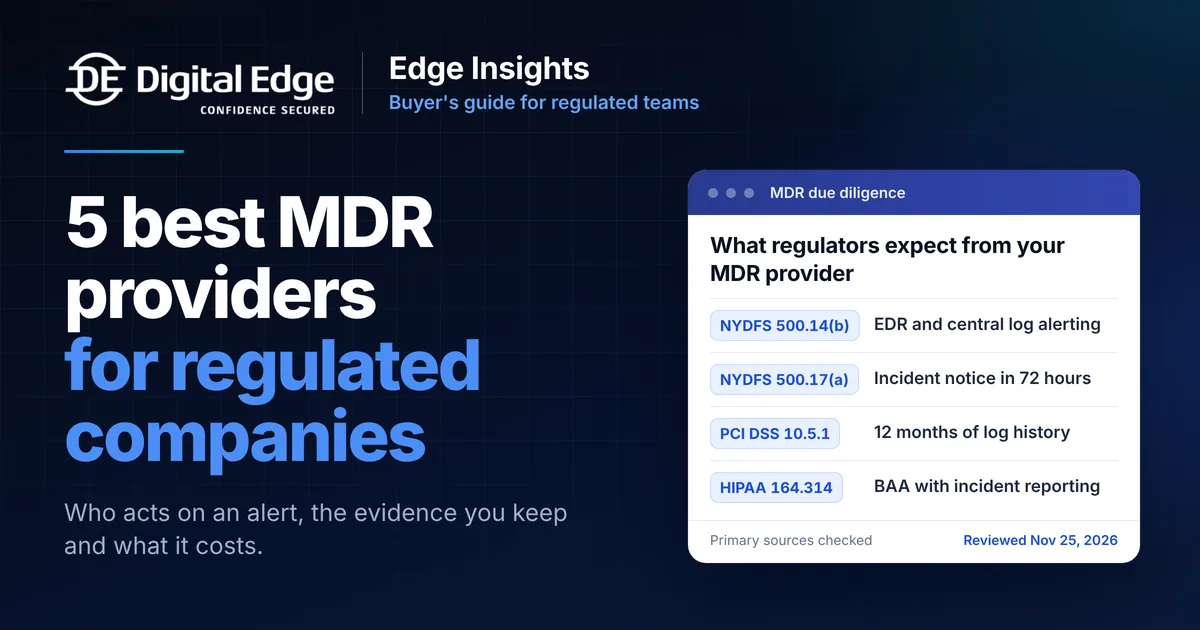
Five MDR providers compared on what regulated teams have to get right: who acts on an alert, how alerts are closed, the evidence you keep and the price.
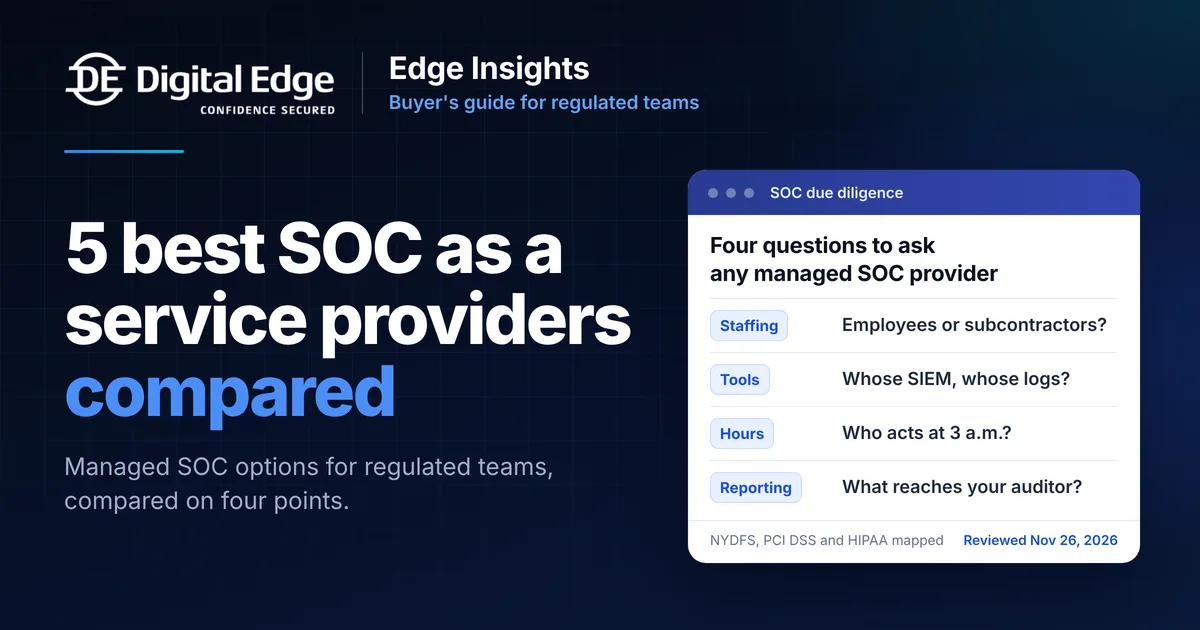
Disclosure: Digital Edge publishes Edge Insights and is one of the five providers in this guide. We list ourselves first and the other four alphabetically; the order is not a ranking. Every provider, including us, is measured against the same four questions and gets a "limits" section. Facts about the other providers come from their own websites, checked on November 25, 2026.
The best MDR providers for regulated companies do three things a generic security vendor may not: they contain an attack on your behalf within limits you agree in advance, they give you evidence an examiner or auditor will accept, and they put both commitments in the contract. Five MDR providers worth shortlisting in 2026 are Digital Edge, Arctic Wolf, eSentire, Expel and Huntress. They differ most in who acts when an alert fires, how long they keep your logs and how they price.
Managed detection and response (MDR) is a service, not a product: a provider watches your environment around the clock, investigates alerts and contains confirmed threats, using its own platform, your security tools and a team of analysts. The usual difference from a traditional managed security service provider (MSSP) is the response. An MDR provider is expected to act, not just forward alerts.
- An MDR provider gives you 24×7 detection and response, but it does not take over your compliance obligations. New York's financial regulator says covered firms cannot delegate compliance to a service provider.
- For regulated buyers, four questions decide the shortlist: who acts on an alert, how alerts are closed and documented, what evidence you keep and how the price is built.
- Check log retention against your strictest rule before you sign. PCI DSS asks for 12 months of audit logs, with the latest three months immediately available.
- If logs or alerts can contain patient data, your MDR provider is a HIPAA business associate and you need a business associate agreement.
- eSentire and Huntress publish per-unit prices, Digital Edge publishes a starting price, and Arctic Wolf and Expel quote on request.
The five providers at a glance
The table summarizes what each provider says about its own service. Where a cell says a detail is not stated, ask for it in writing before you sign.
| Provider | Model | Who acts on an alert | Logs and evidence | Pricing | Best for |
|---|---|---|---|---|---|
| Digital Edge | Own SIEM, AI triage, New York analysts | Your choice: you, shared or Digital Edge | Alerts mapped to SOC 2, HIPAA, PCI DSS, ISO 27001 | From $1,500 a month | Regulated SMBs and mid-market |
| Arctic Wolf | Agentic SOC and a Concierge team | Arctic Wolf contains; Concierge guides fixes | Retention not stated on its MDR page | On request | Firms that want scale and a warranty |
| eSentire | Atlas AI and a 24/7 SOC | eSentire isolates and suspends within agreed policy | 90 days (Enhanced) or 365 days (Elite) | $17 to $28 per user a month | Mid-market firms that want set prices |
| Expel | Works through your tools, no agents | Analysts decide; auto-remediation by package | Workbench shows every action | On request | Teams with a mature security stack |
| Huntress | Own EDR, ITDR and SIEM | Huntress SOC remediates | SIEM retention up to seven years | Per endpoint, identity or data source | Small businesses and MSPs |
How we compared them
We started from the questions regulated buyers ask MDR providers in vendor due diligence, then looked for each answer on the provider's own website. Four criteria carry the weight:
- Who acts on an alert: which containment actions the provider takes itself, which need your approval and which stay with your team.
- How alerts are closed: the mix of automation, AI and human analysts, and whether you can see the reasoning behind each decision.
- What evidence you keep: log retention, reports and incident documentation that will satisfy NYDFS, PCI DSS, HIPAA or a SOC 2 auditor.
- How pricing works: the unit you pay for, what is included and whether prices are published.
Provider facts come from each provider's own pages, read on November 25, 2026. Regulatory statements come from the regulation or the regulator itself. Industry figures come from the original study, with its sample and period. No provider paid to be included, and we have not tested the other four services ourselves, so this guide compares published commitments, not measured performance. We recheck provider facts every six months.
What regulators expect from MDR
No regulation tells you to buy MDR. Several require the outcomes MDR delivers: continuous monitoring, timely detection, documented response and retained logs. All of them leave the responsibility with you, not the provider. The stakes are concrete: the average breach in financial services cost $6.3 million in the 2026 study by IBM and the Ponemon Institute, which covered breaches at 602 organizations between March 2025 and February 2026.
NYDFS Part 500
New York's 23 NYCRR Part 500 requires Class A companies, the largest covered firms by revenue and headcount, to run an endpoint detection and response solution and a solution that centralizes logging and security event alerting, unless the CISO approves an equivalent control in writing (section 500.14(b), in force since May 1, 2025). Every covered entity must notify DFS within 72 hours of determining that a cybersecurity incident has occurred, including one at a third-party service provider (500.17(a)), and must keep the audit trails it uses to detect and respond to material events for at least three years (500.6). Each April 15, the highest-ranking executive and the CISO certify material compliance, based on records kept for five years (500.17(b)).
In its October 21, 2025 guidance on third-party service providers, DFS reminded firms that they cannot delegate compliance to a vendor and listed contract terms to consider: access controls and multi-factor authentication, encryption, notice of cybersecurity events, where data is stored and processed, the use of subcontractors, exit obligations, and whether your data may be used to train AI models. Ask any MDR provider how fast it will tell you about an event so you can meet the 72-hour clock. The rest of Part 500 is covered on our NYDFS 500 compliance page.
PCI DSS v4.0.1
Under PCI DSS v4.0.1, requirement 10.4.1.1, mandatory since March 31, 2025, calls for automated mechanisms to perform audit log reviews. Requirement 10.5.1 asks for 12 months of audit log history, with the most recent three months immediately available for analysis. Requirement 12.10.3 calls for designated people available 24/7 to respond to suspected incidents, and 12.10.5 says the incident response plan must cover alerts from security monitoring systems. If an MDR provider manages any of these for you, requirement 12.8.5 says you must record which requirements it manages, which you manage and which are shared. The PCI Security Standards Council's own FAQ adds that requirements a provider handles are not in place for you unless the provider gives evidence that they are met. Ask for a responsibility matrix before you sign.
HIPAA
The HIPAA Security Rule requires covered entities and business associates to regularly review records of information system activity such as audit logs and access reports, and to identify, respond to, mitigate and document security incidents (45 CFR 164.308). It also requires audit controls that record and examine activity in systems containing electronic protected health information (164.312(b)), and six years of retention for required security documentation (164.316). An MDR provider whose platform creates, receives, maintains or transmits protected health information on your behalf meets the definition of a business associate, so you need an agreement that, among other things, obliges it to report security incidents to you. The January 2025 proposal to overhaul the Security Rule had not been finalized at the time of this review, so the current rule is the one that applies. For the wider program, see our HIPAA compliance services.
GLBA Safeguards Rule
Many fintech and lending companies fall under the FTC's Safeguards Rule rather than a banking regulator. It requires controls that monitor and log the activity of authorized users and detect unauthorized access to customer information, continuous monitoring or, failing that, annual penetration testing and vulnerability assessments every six months, oversight of service providers, and notice to the FTC within 30 days of discovering a notification event that involves at least 500 consumers (16 CFR 314.4).
SOC 2, SEC and DORA
If you sell to enterprises, your SOC 2 auditor will test the criteria for monitoring components for anomalies (CC7.2), evaluating security events (CC7.3) and responding to incidents (CC7.4) in the AICPA Trust Services Criteria, and MDR records are often the evidence. Public companies must disclose a material cybersecurity incident on Form 8-K generally within four business days of determining that it is material, so the provider's investigation timeline feeds that decision. Global fintech firms regulated in the EU also answer to the Digital Operational Resilience Act, which has applied since January 17, 2025 and sets rules for reporting major ICT-related incidents (Article 19) and mandatory contract terms with ICT third-party providers (Article 30). For the rest of the audit, see our SOC 2 compliance services.
Four questions to ask
Every MDR provider promises 24×7 coverage. These four questions show how the service will actually behave in a regulated environment.
Who acts on an alert
Speed is the reason to buy MDR. Mandiant's M-Trends 2026, based on its incident investigations between January 1 and December 31, 2025, put the global median dwell time at 14 days, up from 11, and found that the median time between an attacker's initial access and the hand-off to a second criminal group fell to 22 seconds in 2025, from more than eight hours in 2022. An alert that waits for someone on your side to wake up and approve a host isolation can be too slow.
Regulated firms often limit what outside parties may change, though. In a recent Digital Edge engagement for a regional bank with more than $18 billion in assets, the bank's policy barred vendors from making direct changes in production, so its own engineers executed every change while our team guided them. Before you sign, list which actions the provider takes on its own (isolating a host, disabling an account, revoking sessions, blocking an IP address), which need approval, and who gives that approval at 3 a.m.
How alerts get closed
Every provider on this list uses AI or automation to triage alerts, and the economics support it. In the IBM and Ponemon Institute 2026 Cost of a Data Breach study, organizations that used AI and automation extensively in security saved $1.93 million per breach compared with those that used none, against a global average breach cost of $4.99 million. For a regulated company, the question is not whether AI is used but whether every automated closure leaves a record a person can review: what was checked, what was found and why the alert was closed. Ask for a sample closed alert and a sample escalated incident from a customer in your industry, with identifying details removed.
Treat speed claims as claims. eSentire advertises a 15-minute mean time to contain and Expel a 14-minute mean time to remediate on critical and high incidents; neither page publishes how the figure is measured. Ask when the clock starts and stops, which incidents count, and whether the number is a mean or a median. Independent testing is thin: the most recent round of MITRE ATT&CK Evaluations for Managed Services, a five-day closed-book emulation of the menuPass and ALPHV/BlackCat groups published in June 2024, covered 11 providers, none of them on this list, and MITRE does not rank participants.
What evidence you keep
Logs are your evidence, and short retention leaves gaps. Mandiant warns that intrusions with dwell times close to 400 days leave standard 90-day log retention blind to how the attacker got in. The rules ask for more than 90 days: 12 months for PCI DSS audit logs, at least three years for NYDFS audit trails and six years for HIPAA security documentation. Retention also varies by tier. eSentire's Enhanced package keeps 90 days in its SIEM and Elite keeps 365, while Huntress offers SIEM retention of up to seven years. Ask what the monthly report contains, whether incident reports include a root cause analysis (NYDFS section 500.16 expects one in your incident response plan) and how you export your logs and case history if you leave.
How pricing works
MDR is priced per endpoint, per user, per identity, per data source or by log volume, and the unit shapes what gets covered. eSentire publishes per-user prices on its online store: $17, $24 or $28 per user per month for 10 to 100 users, billed annually, plus a $2,500 yearly launch fee. Huntress prices per endpoint, identity, data source and learner, with its 24/7 SOC included. Digital Edge publishes a starting price for DefenseLine AI of $1,500 a month, with the final quote based on log sources, volume and frameworks. Arctic Wolf and Expel quote on request; Expel states that it charges no extra fees for analyst time or escalations. Whatever the model, ask what is excluded: incident response hours, forensics, onboarding, retention beyond the default and new data sources.
Need these four answers for your environment?
Bring your environment and your last audit or exam findings. In 30 minutes, a Digital Edge engineer will map what MDR should cover for NYDFS, PCI DSS or HIPAA, and the evidence you should expect from any provider.
Digital Edge
What it is. Digital Edge is a New York managed security and compliance provider that has served clients since 1996. Its MDR service runs on Digital Edge's own Elastic SIEM. DefenseLine AI, its AI-native MDR, investigates each alert in several rounds and either closes it with the reasoning logged or escalates it to a Digital Edge analyst.
Strengths
- One stack for detection and compliant log retention, with every closed alert documented and mapped to SOC 2, HIPAA, PCI DSS and ISO 27001 controls.
- Telemetry beyond endpoints: AWS, Azure and Google Cloud, Microsoft 365, Entra ID and Google Workspace, GitHub and GitLab, alongside EDR such as SentinelOne and CrowdStrike.
- A response model you choose: your team drives, the work is shared, or Digital Edge runs response end to end. Escalations go to named engineers in New York.
- Compliance in the same team, including vCISO leadership and programs for NYDFS 500, PCI DSS, HIPAA and SOC 2. Digital Edge holds ISO 27001:2022 and ISO 9001:2015 certifications and signs business associate agreements.
Limits
- One New York team means clear accountability, but global firms that need analysts in other regions or EU data residency should ask how that is handled.
- Digital Edge has not published independent test results for DefenseLine AI. Ask for a proof of value on your own telemetry, as you should with any provider.
- The published starting price covers a defined scope; log sources, volume and frameworks set the final quote.
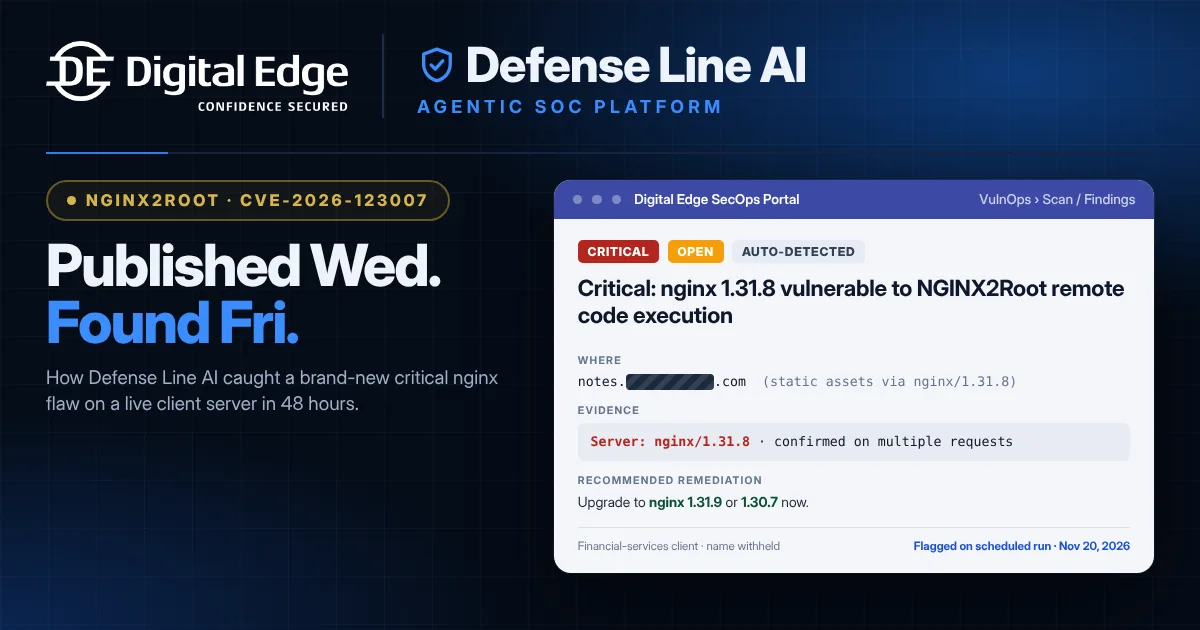
Best for: regulated SMBs and mid-market companies, and enterprise teams in the New York area, that want MDR, compliance evidence and vCISO guidance from one accountable team. For an example of how a finding reaches a client, read how DefenseLine AI handled the NGINX2Root disclosure.
Arctic Wolf
What it is. Arctic Wolf delivers MDR from its Aurora platform, which it describes as an agentic SOC: AI agents run investigations in parallel, and human experts stay in the loop for decisions. Every customer gets its Concierge team, and the company cites more than 10,000 customers.
Strengths
- Scale: Arctic Wolf describes its SOC as one of the largest commercial SOCs, with an open XDR architecture and more than 200 integrations.
- A named Concierge team that runs regular security posture reviews and guides improvements after incidents.
- A Security Operations Warranty of up to $3 million, including compliance-related costs such as a legal assessment after a breach that triggers reporting duties.
Limits
- No published pricing. The warranty reaches its maximum only with Aurora Managed Endpoint Defense plus a Security Operations Bundle on a three-year term; smaller bundles carry lower coverage.
- Its MDR page does not state log retention periods or exactly where Arctic Wolf's containment ends and your remediation begins, so get both in writing.
Best for: mid-market organizations that want a large, established provider, guided security improvement and financial backing if an incident occurs.
eSentire
What it is. eSentire, founded in 2001, runs MDR on its Atlas platform. AI operatives investigate and act at machine speed, and a 24/7 SOC, whose analysts eSentire says average six years of tenure, stays on the loop.
Strengths
- Hands-on containment: host isolation, user suspension, network disruption, file quarantine and retroactive email purges, with actions it describes as policy-bounded, reversible and explainable.
- Published prices for its Professional, Enhanced and Elite packages, with Elite adding 365-day log retention and digital forensics and incident response.
- More than 300 integrations, and unlimited threat hunting and incident handling in its SOC service.
Limits
- Online packages run from 10 to 250 users. Larger or regulated environments are scoped with sales, so the published prices may not apply to you.
- Retention depends on the tier: 90 days in the Atlas SIEM on Enhanced, 365 days on Elite. A PCI DSS entity should budget for Elite or confirm what the extended log storage add-on provides.
- The 15-minute mean time to contain is eSentire's own figure, and its pages do not explain how it is measured.
Best for: mid-market firms with up to a few hundred users that want transparent pricing and a provider that contains threats on their behalf.
Expel
What it is. Expel connects to the security tools you already run, across endpoint, identity, cloud, network and SaaS, through APIs and without agents of its own. Its AI engine, Ruxie, gathers and enriches evidence, and Expel's analysts make the decisions.
Strengths
- Transparency: customers see the same investigations and response actions as Expel's analysts, in real time, in its Workbench platform.
- More than 160 integrations and a quick start. Expel says most customers reach full coverage within two to four weeks.
- Auto-remediation with a plain-language audit trail, and, according to Expel, no extra fees for analyst time or escalations.
Limits
- No published pricing, and capabilities step up by package: auto-remediation across multiple surfaces needs Select, and Workbench API access needs Premium.
- Because Expel works through your tools, coverage is only as broad as the products you already own and connect.
- The 14-minute mean time to remediate applies to critical and high incidents with auto-remediation; ask how it is measured.
Best for: cloud-heavy technology companies with an established security stack that want to see every decision their MDR analysts make.
Huntress
What it is. Huntress sells managed EDR, identity threat detection and response (ITDR) for Microsoft 365 and Google Workspace, managed SIEM and security awareness training, all run by a 24/7 SOC that it describes as AI-centric and human-led. It says more than 285,000 businesses use it.
Strengths
- Simple per-unit pricing, per endpoint, identity, data source or learner, with 24/7 SOC monitoring and remediation included and no feature tiers.
- Long retention: Managed ITDR includes a year of SIEM data retention, and Managed SIEM offers retention of up to seven years.
- Designed with small businesses and the MSPs that serve them in mind, with its own EDR agent that runs alongside existing antivirus.
Limits
- Managed SIEM's Smart Filtering keeps only security-relevant logs. Confirm that it retains every event type your auditor expects, such as the audit events PCI DSS requirement 10.2 lists.
- Published pricing covers the SOC's work but not deployment, integration or day-to-day portal management, which Huntress partners provide.
- Its published scope centers on endpoints, Microsoft 365 and Google Workspace identities and logs; check coverage for cloud control planes such as AWS if they are in scope.
Best for: small businesses and MSP-managed environments, including small healthcare and financial offices, that need affordable 24/7 coverage.
How to choose by size and sector
Startups and SMBs. If you have no security team, buy outcomes rather than tools. Look for a provider that includes the endpoint or identity technology, acts on alerts without waiting for you, and produces the reports your first SOC 2 or HIPAA review will ask for. Published per-unit pricing, as eSentire and Huntress offer, makes budgets predictable. If you also need help with compliance readiness or cloud operations, look at providers that combine MDR with that work, as Digital Edge does.
Mid-market and enterprise. With an internal team, the questions shift to integration and control: which of your tools the provider ingests, whether your analysts can work cases alongside theirs, how escalations reach your on-call staff and whether co-managed response is supported. If you are a Class A company under NYDFS, confirm that the provider's tooling satisfies section 500.14(b), or document the compensating controls your CISO approves. If you need round-the-clock monitoring with your own people in charge, compare MDR with SOC as a service. Digital Edge combines 24/7 security operations with vCISO guidance and continuous compliance monitoring, which suits firms that want one partner across all three.
Financial services and fintech. Map the provider against NYDFS Part 500, the GLBA Safeguards Rule and PCI DSS, and check where data is stored if you operate in the EU under DORA.
Healthcare and health tech. Require a business associate agreement, find out where logs that may contain patient data are stored and for how long, and check that incident reports will support a breach risk assessment.
Technology and cloud-native companies. Insist on coverage of cloud control planes and identity, not just laptops and servers. In the Verizon 2026 Data Breach Investigations Report, which covers incidents from November 1, 2024 to October 31, 2025, exploitation of vulnerabilities was the most common way breaches began (31%), ransomware appeared in 48% of breaches, and a third party was involved in 48%.
See DefenseLine AI on your own environment
AI investigates every alert, a named New York engineer handles what matters, and every decision becomes compliance evidence. Plans start at $1,500 a month.
Frequently asked questions
What does an MDR provider do?
An MDR provider monitors your environment around the clock, investigates alerts and contains confirmed threats, using its own platform, your security tools and a team of analysts. Unlike a traditional MSSP, it is expected to act on threats rather than only forward alerts to you.
Does using an MDR provider make us compliant?
No. An MDR provider supplies controls and evidence, but the responsibility stays with you. NYDFS states that covered entities cannot delegate compliance to a third-party service provider, and PCI DSS requires you to record which requirements a provider manages on your behalf.
Do we need a business associate agreement with our MDR provider?
If the provider's platform creates, receives, maintains or transmits protected health information for you, for example inside the logs or email it analyzes, it is a business associate under HIPAA and you need a business associate agreement.
How long should an MDR provider keep our logs?
At least as long as your strictest rule requires: 12 months for PCI DSS audit logs, with three months immediately available, and three years for NYDFS audit trails. HIPAA requires six years for security documentation. Many standard tiers keep 90 days, so check before you sign.
How much does MDR cost?
Among the providers in this guide, published prices start at $17 per user per month for eSentire's entry package, plus a $2,500 yearly launch fee, and at $1,500 a month for Digital Edge's DefenseLine AI. Huntress prices per endpoint, identity and data source, while Arctic Wolf and Expel quote on request. Coverage, retention and included incident response hours change the total, so compare like for like.
Is AI-driven MDR acceptable to regulators?
None of the regulations covered here prohibit it, but you remain accountable for decisions made on your behalf. Ask for the logged reasoning behind automated closures, and agree in the contract whether your data may be used to train AI models, a term NYDFS lists in its guidance on third-party service providers.
Sources and review date
Reviewed November 25, 2026. The next review is due in May 2027. Provider facts come from each provider's own website on the review date and are linked in each section.
Regulations and standards: 23 NYCRR Part 500 and the NYDFS industry letter of October 21, 2025; PCI DSS v4.0.1; 45 CFR Part 164; 16 CFR 314.4; the AICPA Trust Services Criteria; the SEC cybersecurity disclosure rule; and Regulation (EU) 2022/2554 (DORA).
Studies: IBM and Ponemon Institute, Cost of a Data Breach Report 2026 (breaches at 602 organizations, March 2025 to February 2026); Verizon, 2026 Data Breach Investigations Report (incidents from November 1, 2024 to October 31, 2025); Mandiant, M-Trends 2026 (Mandiant investigations in 2025); MITRE, ATT&CK Evaluations for Managed Services, Round 2 (2024).