5 Best SOC as a Service Providers (Managed SOC) Compared
Five managed SOC providers compared on staffing, tool ownership, hours and the reports you get.
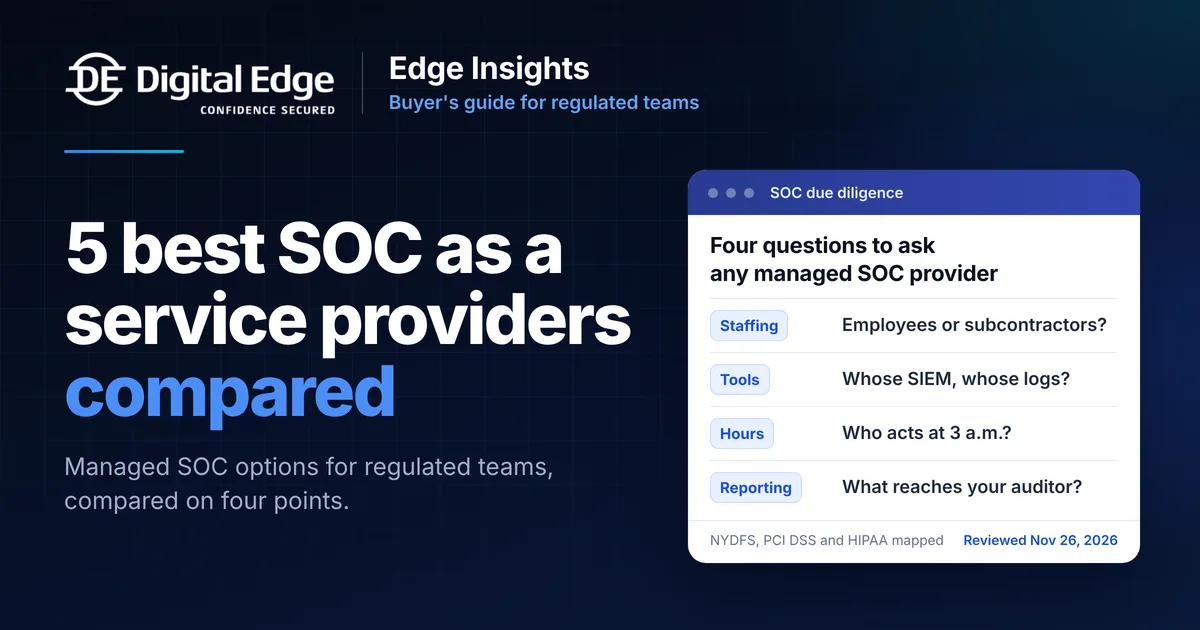
Five SOC as a service providers compared for regulated teams: who staffs the SOC, who owns the tools, when people are on shift and what reaches your auditors.
Disclosure: Digital Edge publishes Edge Insights and is one of the five providers in this guide. We list ourselves first and the other four alphabetically; the order is not a ranking. Every provider, including us, is compared on the same four points and gets a "limits" section. Facts about the other providers come from their own websites, checked on November 26, 2026.
The best managed SOC providers for a regulated company tell you plainly who watches your environment, whose tools they use, when a person is on shift and what you get in writing. Five SOC as a service providers worth shortlisting in 2026 are Digital Edge, Arctic Wolf, Critical Start, Deepwatch and LevelBlue, which acquired Trustwave in 2025. They differ most in staffing model, tool ownership, how they handle nights and weekends, and reporting.
- Managed SOC, SOC as a service and MDR overlap. Compare what the contract covers, not the label.
- You can outsource SOC work but not accountability. NYDFS, the GLBA Safeguards Rule and HIPAA each keep a named person on your side responsible.
- One analyst seat around the clock takes about five people. At the 2025 median wage for information security analysts, that is roughly $646,000 a year in pay before benefits, tools and management.
- Settle tool and data ownership before you sign: who holds the SIEM and EDR licenses, where logs live and how you get them back at exit.
- Digital Edge publishes a starting price; Arctic Wolf, Critical Start, Deepwatch and LevelBlue quote on request.
Managed SOC vs SOCaaS vs MDR
A managed SOC is an outsourced security operations center: the provider's analysts monitor your environment around the clock, triage alerts, investigate and either respond or escalate to your team. SOC as a service is usually the same thing sold as a subscription, often with the provider's own platform included. Providers use the two labels loosely, so read the contract: some run their own SIEM and give you a portal, others staff tools you already own, and a co-managed SOC splits the work between their analysts and yours.
MDR (managed detection and response) is narrower. It is judged on finding and containing threats, often on endpoints, identities and cloud accounts, and it does not necessarily include log management or compliance reporting. A SOC service can cover more of what a SOC does, which the 2026 SANS SOC Survey shows extends to alert triage, compliance support, data protection and digital forensics. Because the services overlap, this guide compares what each provider commits to on four points: who staffs the work, who owns the tools, when people are on shift and what reports you receive.
The five providers at a glance
The table summarizes what each provider says about its own service. Where a cell says a detail is not described, ask for it in writing before you sign.
| Provider | Staffing model | Tool ownership | Hours and escalation | Reporting | Best for |
|---|---|---|---|---|---|
| Digital Edge | Own employees in three tiers, named New York engineers | Its own SIEM, or your tools integrated into it | 24×7×365; Tier 2 on shift, Tier 3 on call | Live dashboard; alerts mapped to compliance controls | Regulated SMBs and mid-market firms |
| Arctic Wolf | Agentic SOC with humans in the loop; a named Concierge team | Its own platform, open to 200+ integrations | 24×7 | Posture reviews with the Concierge team | Mid-market firms that want a guided program |
| Critical Start | U.S.-based analysts; support model set by tier | Your tools; response through 30+ integrations | 24/7; SLA-backed notification | Live, signed audit log; reviews by tier | Enterprises that want contractual SLAs |
| Deepwatch | SOC analysts, detection engineers and threat hunters | Your tools; works across SIEMs | 24/7/365; off-hours rules you set | Visibility into decisions; posture roadmap | Enterprises with a SIEM they keep |
| LevelBlue | Global teams including SpiderLabs; co-managed option | Your SIEM (co-managed) or its own platforms | 24/7/365 | Not described on its service page | Large firms buying many services from one provider |
How we compared them
We read each provider's own pages on November 26, 2026 and noted what it commits to on four points:
- Staffing model: who the analysts are, how work moves between tiers and whether you get a named contact.
- Tool ownership: whose SIEM, EDR and log store the service runs on, and what that means for your data at exit.
- Hours and escalation: what happens at night and on weekends, and which actions the provider may take without you.
- Reporting: what you can see live, what arrives in writing and how it maps to the frameworks you answer to.
Regulatory statements come from the rule itself, and industry figures come from the original study, with its sample and period. No provider paid to be included, and we have not tested the other four services ourselves, so this guide compares published commitments, not measured performance. Independent tests are thin: none of the five providers here appears among the 11 that took part in MITRE's 2024 ATT&CK Evaluations for Managed Services, a five-day closed-book emulation of the menuPass and ALPHV/BlackCat groups. We recheck provider facts every six months.
What regulators expect from a SOC
No regulation requires you to buy a SOC. The rules regulated companies answer to decide something more useful: who stays accountable when outsiders do the work.
| Rule | Who must do or own the work | What to put in the contract |
|---|---|---|
| NYDFS Part 500, sections 500.4 and 500.10 | Qualified cybersecurity personnel, who may be your own, an affiliate's or a third-party service provider's; your CISO may work for a provider, but you keep responsibility | Named roles, qualifications and training, and a senior person on your side who oversees the provider |
| NYDFS section 500.11 and October 2025 guidance | A written policy for third-party service providers; compliance cannot be delegated | Event notice timing, where data is stored, subcontractors, exit and deletion, and whether your data may train AI models |
| GLBA Safeguards Rule, 16 CFR 314.4(a) | A Qualified Individual, who may work for a service provider if you keep responsibility, name a senior overseer and require the provider to keep a security program | Those three conditions, in writing |
| HIPAA, 45 CFR 164.308 and 164.314 | A security official you identify; a business associate agreement when the provider handles ePHI | A BAA that requires incident reporting; your security official stays named |
| PCI DSS v4.0.1, 12.10.3 and 12.8.5 | People available 24/7 to respond to suspected incidents; a record of which requirements the provider manages | A responsibility matrix and the provider's 24/7 response commitments |
| SOC 2, criteria CC7.2 to CC7.4 | Monitoring, evaluation of security events and incident response, tested by your auditor | Evidence and reports for the whole audit period |
Sources for the table: 23 NYCRR Part 500 and the NYDFS guidance on third-party service providers of October 21, 2025; the FTC's Safeguards Rule; the HIPAA rules on the security official and business associate contracts; PCI DSS v4.0.1; and the AICPA Trust Services Criteria.
Two clocks also shape what you need from the provider. NYDFS expects notice within 72 hours of determining that a cybersecurity incident occurred, including one at a third-party service provider, and the GLBA Safeguards Rule requires notice to the FTC within 30 days of discovering an event that involves at least 500 consumers. A provider whose reports arrive monthly cannot carry those deadlines alone, so ask how fast it tells you and in what form. Our pages on NYDFS 500, HIPAA, PCI DSS and SOC 2 cover the rest of each program.
Four things to compare
Every provider in this guide promises round-the-clock coverage. These four points show how the service will actually run in your environment.
Staffing model
People are the scarce input. In the 2026 SANS SOC Survey, which drew 444 responses from security operations practitioners and a parallel survey of 69 CISOs and senior executives, cyber leaders named human capital as the biggest limit on funding their priorities. 59% of leaders said management pays close attention to SOC hiring and retention, while only 32% of practitioners agreed. The same survey found that alert triage is run in-house by 55% of respondents, shared with an outside provider by 35% and fully outsourced by 9%, and that 24/7 monitoring is among the functions most often outsourced, frequently for off-hours coverage.
The arithmetic explains why. One seat staffed around the clock covers 8,760 hours a year. If an analyst works about 1,880 hours after leave and training, which is our assumption, one seat needs 4.7 people, so five in practice. The U.S. Bureau of Labor Statistics puts the median annual wage for information security analysts at $129,180 in May 2025, so five analysts cost about $646,000 a year in pay alone, before benefits, management, tools and turnover. That buys one seat, with no second analyst to help during an incident.
Ask each provider whether its analysts are employees or subcontractors, where they work, how work moves between tiers and whether you get a named contact. Also decide who on your side oversees them: NYDFS, the GLBA Safeguards Rule and HIPAA all expect a person in your organization to stay accountable, and a vCISO can fill that role where the rules allow.
Tool ownership
Decide who owns the SIEM, the EDR and the logs before you compare prices. If the provider brings its own platform, you start faster, but your detection history lives in its system. If it runs your tools, you keep the licenses and the data, and the provider needs access rights to act in them. Regulated firms often limit that access. In a recent Digital Edge engagement for a regional bank with more than $18 billion in assets, the bank barred vendors from making direct changes in production, so its own engineers executed every change while our team guided them.
Third parties also feature in many breaches. The Verizon 2026 Data Breach Investigations Report, which covers incidents from November 1, 2024 to October 31, 2025, found a third party involved in 48% of breaches. NYDFS's October 2025 guidance lists the terms to settle up front, including where data is stored and processed, which subcontractors touch it, what happens to it at exit and whether it may be used to train AI models. Ask for log export in a usable format, and confirm how long the provider keeps your data after the contract ends.
Hours and escalation
Speed is why you pay for round-the-clock coverage. Mandiant's M-Trends 2026, based on its incident investigations between January 1 and December 31, 2025, put the global median dwell time at 14 days and found that the median time between an attacker's initial access and the hand-off to a second criminal group fell to 22 seconds. PCI DSS requirement 12.10.3 already expects specific people to be available 24/7 to respond to suspected incidents.
What matters is what the provider may do at 3 a.m. without you. Some let you set the rules in advance: Deepwatch describes a response matrix in which you decide which actions run automatically off-hours and which wait for analyst approval, and Critical Start says you approve or reject containment actions and set escalation preferences. Write down which actions the provider takes alone (isolating a host, disabling an account, revoking sessions), which need approval and who approves at night.
Reporting
Reports are how the SOC's work becomes evidence. NYDFS requires your CISO to report to the board in writing at least once a year, and your highest-ranking executive and CISO to certify compliance each April 15, based on records kept for five years. A SOC 2 auditor tests monitoring and incident response across the whole audit period, and HIPAA requires six years of retention for security documentation. Ask for a sample monthly report and a sample incident report with root cause, check whether you can see investigations live or only in summaries, and confirm that reports map to the frameworks you answer to.
Automation changes what reporting can show. In the IBM and Ponemon Institute 2026 Cost of a Data Breach study, based on breaches at 602 organizations between March 2025 and February 2026, organizations that used AI and automation extensively in security saved $1.93 million per breach compared with those that used none, against a $4.99 million global average. If a provider closes alerts with AI, ask for the logged reasoning behind each closure, so your reports can show what was checked and why.
Weighing an outsourced SOC against hiring?
Bring your current tools and your last audit or exam findings. In 30 minutes, a Digital Edge engineer will show what a managed SOC should own, what stays with your team and the evidence you should expect from any provider.
Digital Edge
What it is. Digital Edge is a New York managed security and compliance provider that has served clients since 1996. Its SOC as a service is run by Digital Edge employees, not subcontractors, in three tiers: alert analysts around the clock, incident responders on shift and subject matter experts on call. DefenseLine AI, its AI-native MDR, investigates each alert before an analyst sees it.
Strengths
- Your choice of tooling: Digital Edge deploys its own SIEM or integrates the monitoring tools you already run, and the same stack provides compliant log retention.
- Reporting built for audits: a live dashboard, and every closed alert documented and mapped to SOC 2, HIPAA, PCI DSS and ISO 27001 controls.
- One team for adjacent work: vCISO leadership, a 24×7 NOC, cloud operations and compliance programs for NYDFS 500, PCI DSS, HIPAA and SOC 2.
- Holds ISO 27001:2022 and ISO 9001:2015 certifications and signs business associate agreements.
Limits
- One New York team means clear accountability, but global firms that need analysts in other regions or EU data residency should ask how that is handled.
- Digital Edge publishes a starting price only for DefenseLine AI, from $1,500 a month; SOC as a service is quoted on scope.
- It has not published independent test results. Ask for a proof of value on your own telemetry, as you should with any provider.
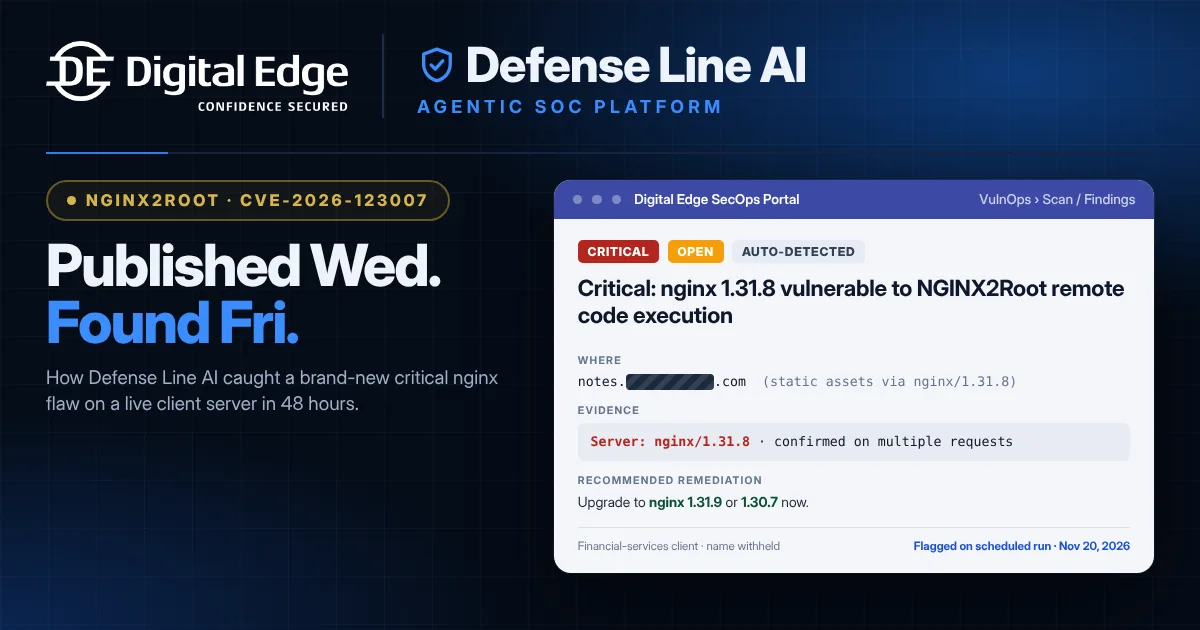
Best for: regulated SMBs and mid-market companies that want SOC coverage, vCISO guidance and compliance evidence from one accountable team. To see how a finding reaches a client, read how DefenseLine AI handled the NGINX2Root disclosure.
Arctic Wolf
What it is. Arctic Wolf runs its MDR and security operations through its Aurora platform and what it calls an Agentic SOC: AI agents work each case in parallel while security experts guide decisions. The company cites more than 10,000 customers and more than 1,000 security engineers.
Strengths
- A named Concierge team for every customer, which ran more than 74,000 security posture reviews in 2025 by Arctic Wolf's count.
- An open XDR architecture with more than 200 integrations, plus its own endpoint product if you want one.
- A Security Operations Warranty of up to $3 million, depending on the bundle and contract term.
Limits
- No published pricing, and the largest warranty requires its own endpoint product and a three-year term.
- The Concierge team guides improvements; confirm in the contract who carries out remediation and changes in your systems.
- Log retention periods are not stated on its MDR page.
Best for: mid-market organizations that want a large provider with a guided security program and are comfortable running on its platform.
Critical Start
What it is. Critical Start runs MDR from a U.S.-based SOC on its CORR platform. A registry of known-good behavior closes most false positives automatically, human analysts investigate the rest, and response actions run inside your existing tools.
Strengths
- Contractual SLAs: the company advertises a 10-minute notification SLA with service credits, a monthly mean-time-to-respond SLA on its Enterprise tier and per-alert response SLAs on its Signature tier.
- Your tools and your data: no proprietary agents, with response run in your endpoint, identity, email and network tools through more than 30 two-way integrations.
- A live, signed audit log of each investigation, with the analyst's reasoning and every action taken, plus two-person verification for critical findings.
Limits
- No published pricing. Quotes depend on your environment and tier, and the deepest SLAs come with the top tier.
- Response is only as broad as the integrations: for cloud platforms its page lists advisory and detection actions, and OT monitoring is read-only.
- The 99.83% auto-resolution rate and five-minute average detection time are Critical Start's own figures, and its page does not explain how they are measured.
Best for: enterprises that want SLAs with financial remedies and full visibility into every investigation.
Deepwatch
What it is. Deepwatch delivers MDR through its Guardian MDR Platform, which pairs its NEXA AI with oversight from SOC analysts, detection engineers, threat hunters and response experts, around the clock.
Strengths
- Bring your own technology: the platform works with the SIEM, endpoint, cloud, identity and network tools you already run, including Splunk and Securonix, and Deepwatch cites more than 800 supported telemetry sources.
- Response rules you define: a Response Intent Matrix sets which detections may trigger action, which actions run automatically and when, and which need analyst approval.
- A patented Security Index that turns findings into a roadmap for your security posture.
Limits
- Active Response covers identities and endpoints today; Deepwatch says other domains will follow.
- No published pricing.
- Deepwatch is repositioning as an autonomous SOC platform under a CEO appointed in May 2026, so ask how the human role in your service will change.
Best for: enterprises that want a managed SOC on the SIEM and security tools they already own.
LevelBlue
What it is. LevelBlue is a managed security services provider that completed its acquisition of Trustwave in August 2025 and has also acquired Cybereason. Its threat detection and response portfolio includes MDR, managed extended detection and response (MXDR) and a co-managed SOC that runs on your SIEM.
Strengths
- Breadth: one provider for MDR, co-managed SOC, incident response, offensive security and advisory, backed by the SpiderLabs team of more than 1,000 consultants, threat hunters, incident responders and researchers.
- A co-managed option that pairs your analysts with LevelBlue's around the clock on the SIEM you already own.
- LevelBlue says it is the only pure-play MDR provider with FedRAMP certification, which matters if you serve government agencies. It also says onboarding takes days.
Limits
- Its services page lists both its USM Anywhere platform and Trustwave's Fusion platform, and Cybereason has since joined. Ask which platform your service runs on and whether it will change during the contract.
- No published pricing; its service page invites a pricing request.
- Report content is not described on its threat detection page, so ask for samples.
Best for: large and global organizations that want one provider across managed security, incident response and testing.
How to choose by size and sector
Startups and SMBs. If you have no security staff, choose a provider that supplies the platform or runs on what you already have without extra licenses, acts on alerts at night under rules you agreed, and produces the reports your first SOC 2 or HIPAA review will ask for. If you also need help with compliance readiness or cloud management, a provider that combines the SOC with that work, as Digital Edge does, saves a second contract.
Mid-market and enterprise. With an internal team, choose between fully managed and co-managed. Co-managed models, such as LevelBlue's co-managed SOC or Deepwatch's work on your SIEM, suit teams with their own SIEM and analysts. Fully managed suits teams that want the provider to own the night shift. Check how escalations reach your on-call staff, whether your analysts can work cases in the provider's platform, and whether a vCISO should own the program, as NYDFS and the GLBA Safeguards Rule allow.
Financial services and fintech. Map the provider against NYDFS Part 500 (sections 500.4, 500.10, 500.11 and 500.17) and the GLBA Safeguards Rule, and ask for the provider's own third-party attestations, such as SOC 2 or ISO 27001 reports.
Healthcare and health tech. Require a business associate agreement, find out where logs that may contain patient data are stored and for how long, and keep your security official named on your side.
Technology and cloud-native companies. Ask for coverage of cloud control planes and identity providers, not only laptops and servers, and check that response actions exist for them. Response options on cloud platforms differ: Critical Start's page, for example, lists advisory and detection actions for cloud today.
Need a SOC and a CISO who owns the program?
Digital Edge pairs a 24×7 in-house SOC with vCISO leadership and compliance support, so one team answers for detection, response and the evidence your examiners ask for.
Frequently asked questions
What is a managed SOC provider?
A managed SOC provider runs security operations for you. Its analysts monitor your environment around the clock, triage and investigate alerts, and respond or escalate, using its own platform or tools you already own.
What is the difference between a managed SOC and SOC as a service?
Little in practice. Both describe an outsourced SOC. SOC as a service usually means a subscription that includes the provider's platform, while a managed or co-managed SOC can run on tools you own. Compare contracts, not labels.
Is SOC as a service the same as MDR?
They overlap. MDR focuses on detecting and containing threats, while a SOC service can also include log management, compliance reporting and other monitoring. Check what each contract includes.
Can we outsource our SOC and still meet NYDFS or HIPAA?
Yes, but responsibility stays with you. NYDFS lets you use a third-party service provider's personnel, and even a CISO employed by a provider, as long as you keep oversight. HIPAA requires you to identify your own security official and to sign a business associate agreement with any provider that handles ePHI.
How much does a managed SOC cost?
Most providers quote on request. Of the five in this guide, only Digital Edge publishes a starting price: $1,500 a month for DefenseLine AI. For comparison, staffing one 24/7 seat in-house takes about five analysts, roughly $646,000 a year in median pay alone.
What should a SOC report include?
At minimum: alerts handled and how they were closed, incidents with timelines and root cause, response actions taken, open risks, and evidence mapped to the frameworks you answer to. You should also be able to see investigations live, not only in monthly summaries.
Sources and review date
Reviewed November 26, 2026. The next review is due in May 2027. Provider facts come from each provider's own website, checked on the review date.
Regulations and standards: 23 NYCRR Part 500 and the NYDFS industry letter of October 21, 2025; 16 CFR 314.4; 45 CFR Part 164; PCI DSS v4.0.1; and the AICPA Trust Services Criteria.
Studies and data: SANS Institute, 2026 SANS SOC Survey (444 practitioners and 69 senior leaders, published June 2026); U.S. Bureau of Labor Statistics, Occupational Outlook Handbook (May 2025 wage data); Verizon, 2026 Data Breach Investigations Report (incidents from November 1, 2024 to October 31, 2025); Mandiant, M-Trends 2026 (investigations in 2025); IBM and Ponemon Institute, Cost of a Data Breach Report 2026 (602 organizations, March 2025 to February 2026); MITRE, ATT&CK Evaluations for Managed Services (2024).