Offensive vs Defensive Security: Hackers Are Wolves, Defenders Are Shepherds
A short solo episode on quiet defense, hack-back and shiny products

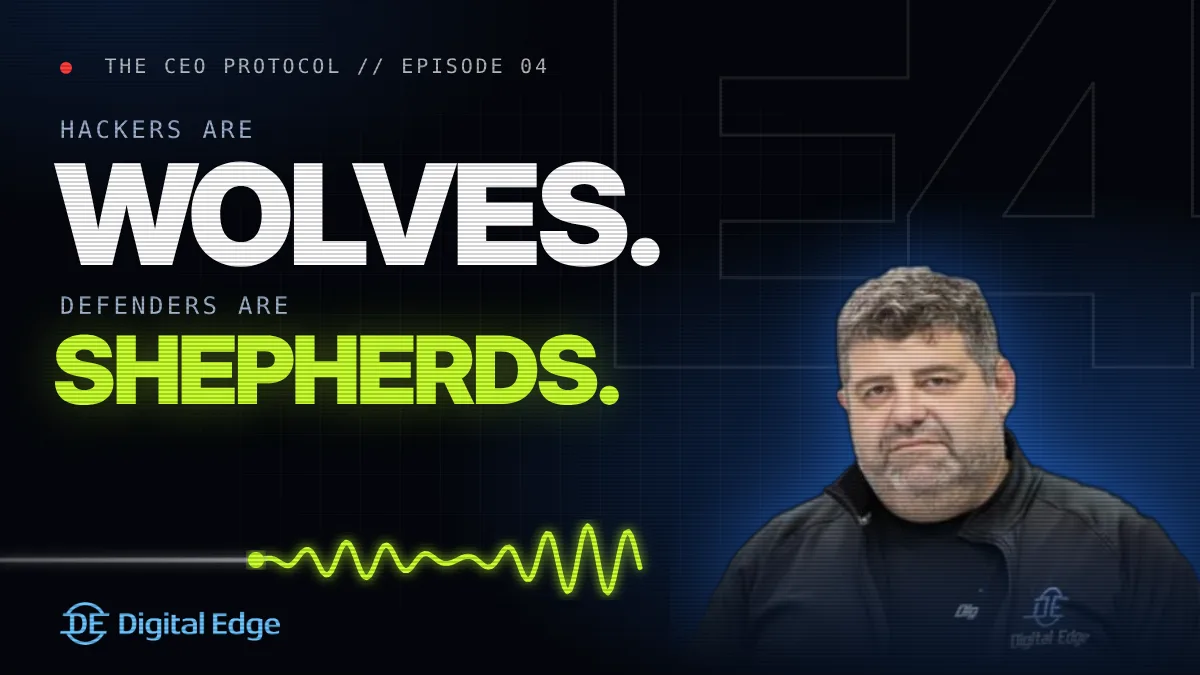
Offensive vs defensive security calls for different skills and different mindsets. Digital Edge CEO Michael Petrov explains why defenders stay quiet, why hack-back is a bad plan and why shiny products deserve a hard look.
Offensive vs defensive security is not a question of how hard you hit back. In this short solo episode of The CEO Protocol, Digital Edge CEO Michael Petrov explains why hunting and protecting are two different professions, and why a business whose job is not security does best by staying quiet.
Petrov calls the hacker a wolf and the defender a shepherd. Understanding how the wolf thinks is an advantage. Defending with the wolf's mindset is not.
In this episode
- Why the skills of a hacker and the skills of a defender are completely different
- Why knowing how attackers think helps, and why defending with that mindset does not
- A story from a friend who laid minefields, and what it shows about noise and firepower
- Why quiet defense, with locks, alarms and monitoring, beats "hack back" security
- How loud moves can put a business on an attacker's list of targets
- Why the hot security product of the moment is often a marketing win, not a performance win, and what to ask before you buy
Listen and watch
The episode runs about seven minutes. Watch it on YouTube or listen on Spotify.
Where to go next
Every year a new must-have appears in security, and clients ask why they do not have it yet. The questions that matter are what a product does for your environment, who runs it and how you will know it works. Digital Edge's managed detection and response service takes the shepherd's side: our in-house team watches your environment around the clock, locks the doors, sets the alarms and keeps your business off the target list. Learn more about Digital Edge or about DefenseLine.ai.
Read the transcript
Hello friends and colleagues, this is my solo Security Operations Advisory. I wanted to speak today about a very funny subject, and this is offensive cyber security. Me as kind of in my role it amuses me how marketing people are twisting things to make it to bite and overall before I jump into that subject I can say that today all more or less mature companies they are the same and features and performance they like a little bit above the other but sometimes some company just shoots up in terms of like visibility and our clients are like why we are not implementing these they are so hot today Google bought them and the thing is that today it's not a war of technology or features it's war of marketing because when you look that company wouldn't have so much money in marketing but feature-wise sometimes they are even behind other leaders and if one company is like very hot today it may not be hot in six months because something else will be more fancy tomorrow just because they outperform on the marketing not on the features not on the actual performance so I just wanted to make sure that I mentioned that guys don't follow shiny things because you are not fish and you know sometimes there is a hook in that shiny little bait so I wanted to tell you my opinion about that offensive cyber security look there are in our engineering world there are only two professions one is a hacker who is a wolf another one is a shepherd who is defending or teaching you how to defend or setting up operations to defend and the skill set of hunting is totally different from skill set of protecting even like personal security people they know that if you were like a navy seal or whatever they have like completely different mindset than guys that are defending things so it's advantage to understand a hacker's mentality and what they do and how they're doing it but it's definitely not a good thing to apply that skill in the defense let me give you another my personal example so I as many of you know I was I graduated from military academy and I've been to a few situations and a friend of mine an engineer was telling me that he hates and he was responsible for setting up minefields in Afghanistan and he was saying I hate when we get this assignment and some special force units are attached to us to to protect us so because their mentality is to attack be aggressive like be always in the fight now mentality of the engineers they have an assignment and they have to quietly get their get it done and pull out that's it work is done so so he says that we are deploying the the minefield and we have this special force unit attached to them and there is like one gunshot and they start shooting at that gunshot he's like we our work as engineers you have to you know hide your head behind armored vehicle and complete complete your assignment rather than you know go go to that fight and I'm not saying that all special forces units like this and it could be specific to that special forces unit but he said that you know out of that one shot it was such a war and these guys created so much mess and then first they were advancing then they were saying okay we have to get out of there and they basically evacuated for like nothing and they forgot to remove the fire beam and that minefield was some sort of secret that they had to redeploy again and you know like remove that that you know that safety and so he was saying that you know sometimes that firepower and you know making noise is not something that you really need so same thing in cyber security you have to defend wouldn't mean offensive yeah you could do pen test and you could use all the techniques and you know like minor attack thing but when you are sitting and doing your work and you are I don't know in any business you know has your business has nothing to do with cyber security has nothing to do with what you want to be is least visible less visible you know you know don't go into fights you protect yourself and you know it's not your profession to you know be in all the fights and I can tell you that people we see that some cyber security company will say oh we'll fight back we'll hug them back and you know it's it's not our business we wanted to make sure that we lock all the doors lock all the windows have all the bootstraps to see if someone getting you know set up alarm systems and things like that that's it quietly we don't need to go into fight you come to us we should be prepared to meet the hacker but we don't want to make even noise because even scraped kitties would notice it and you know and put you on the list of potential targets so once it quietly you know we don't want targeted attacks so this offensive defense through offensive security is is just funny to me it's just shiny term that you know some security companies are using so I would be very kind of questionable about their performance and what they are doing thank you bye